Published research on the reference compound class. Provided for scientific context only. Not a claim about the product supplied.
What it is
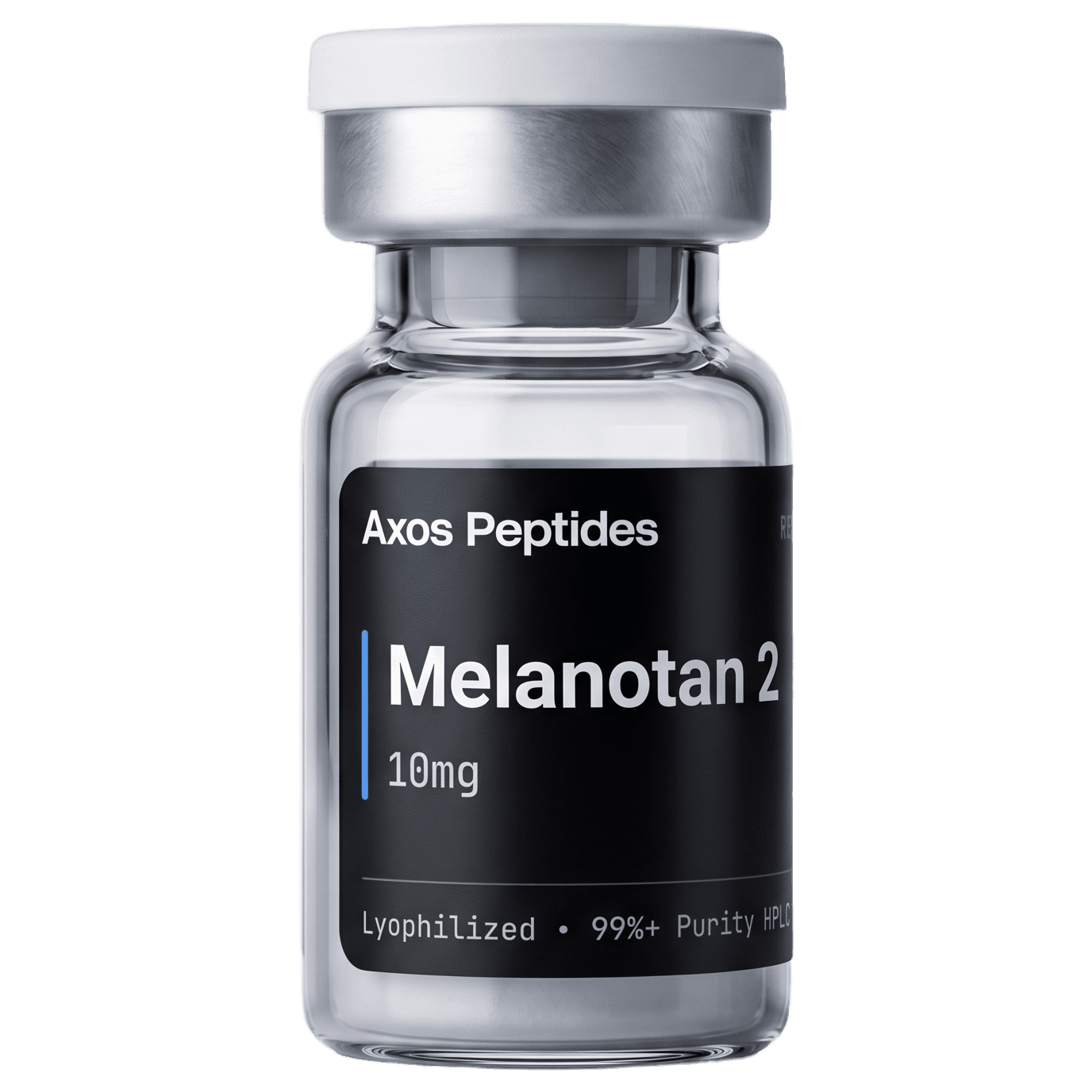
Alpha-MSH is the hormone that tells pigment cells to make melanin. Melanotan II is a synthetic copy of it. It is built as a ring, closed by a bridge, which makes it far more potent than the natural hormone.1
The original pharmacology appeared in 1996, in a pilot phase-1 study. It reported tanning activity in humans.1 That study is the compound's foundation. It is also close to where its formal clinical development stopped.
It acts on melanocortin receptors. PT-141 works through the same receptor family. That is why the two share an unexpected set of effects.1 PT-141 has its own page.
Identity
- Cyclic alpha-MSH analogue
- Class
- Melanocortin receptors
- Targets
- 1996
- First human study · Pilot phase 1
- No
- Approved anywhere
What dermatologists have published
This is the part of the record that matters, and it is not what most product pages describe.
A 2017 review in the *International Journal of Dermatology* surveyed the risks of unregulated alpha-MSH analogue use. Its finding was direct.2
Increasing numbers of case reports indicate that unregulated use of both melanotan I and II is associated with skin complications. The specific changes named are melanocytic changes in existing moles, and newly emerging dysplastic moles.2
The individual reports behind that conclusion come from several countries and separate teams.
- Eruptive new moles. A 2009 report in the *British Journal of Dermatology* described eruptive melanocytic naevi following melanotan use.6
- Melanoma. A 2011 report described melanotan-associated melanoma.4 A 2012 report described melanoma in situ.5
- A detailed case. A 20-year-old woman with fair skin was referred with a suspicious black lesion. Histology confirmed melanoma. Three months earlier she had completed a three to four week course of melanotan II, alongside sunbed use.3
- A urological emergency. A 2019 case report describes acute low-flow priapism after melanotan use. It was managed with aspiration and irrigation. The patient had not recovered erectile function at four-week follow-up.7
- 2017
- review finding an association with melanocytic change2
- 0
- regulatory approvals for melanotan II
What case reports can and cannot establish
This distinction is worth getting right, in both directions.
A case report describes what happened to one patient. It can raise an alarm quickly. It cannot prove that one thing caused another.3
The authors of the melanoma case are careful about exactly this. They write that the melanocyte stimulation coincided with cutaneous melanoma.3
There is a second problem. People who use tanning compounds also tend to use sunbeds, and UV exposure is an established melanoma risk on its own. The patient in that report used both.3 Separating the two would take a controlled study, and nobody has run one.
The 2017 review adds a concern that has nothing to do with biology. Material bought outside regulated supply raises questions about preparation and content.2 In plain terms: what is actually in the vial. That is a purity and identity question, and a certificate can answer it.
The one approved analogue is a different molecule
Melanotan II is often confused with melanotan I. They are not the same, and their regulatory status could not be further apart.
Afamelanotide, also called melanotan I, has been thoroughly tested. It is approved for a limited number of medical indications.2
Melanotan II is not approved anywhere. The 2017 review describes the melanotans circulating outside regulated channels as untested.2
If you see a claim that melanotan is approved, check which one is meant. The approval belongs to the other molecule.
Where this leaves the evidence
- The pharmacology is real. A 1996 pilot study reported tanning activity in humans.1
- The safety literature is case reports, and it points one way. Melanocytic change, new dysplastic moles, and several melanoma reports.2345
- No controlled safety study exists. Nobody has run the trial that would settle the melanoma question either way.
- Effects extend past pigmentation. The melanocortin receptor family is shared with compounds studied for sexual function. A priapism case has been published.7
Sources
Numbered as cited in the text · how we source
- 1
Evaluation of melanotan-II, a superpotent cyclic melanotropic peptide in a pilot phase-I clinical study
Dorr RT, Lines R, Levine N, et al. · Life Sci. 1996;58(20):1777-1784 · 1996
Phase 1PubMed 8637402 - 2
Risks of unregulated use of alpha-melanocyte-stimulating hormone analogues: a review
Habbema L, Halk AB, Neumann M, Bergman W · Int J Dermatol. 2017;56(10):975-980 · 2017
ReviewPubMed 28266027 - 3
Melanoma associated with the use of melanotan-II
Hjuler KF, Lorentzen HF · Dermatology. 2014;228(1):34-36 · 2014
Case reportPubMed 24355990 - 4
Melanotan-associated melanoma
Paurobally D, Jason F, Dezfoulian B, et al. · Br J Dermatol. 2011;164(6):1403-1405 · 2011
Case reportPubMed 21564053 - 5
Melanotan-associated melanoma in situ
Ong S, Bowling J · Australas J Dermatol. 2012;53(4):301-302 · 2012
Case reportPubMed 22724573 - 6
Eruptive melanocytic naevi following melanotan injection
Cousen P, Colver G, Helbling I · Br J Dermatol. 2009;161(3):707-708 · 2009
Case reportPubMed 19575725 - 7
Melanotan-induced priapism: a hard-earned tan
Dreyer BA, Amer T, Fraser M · BMJ Case Rep. 2019;12(2):e227644 · 2019
Case reportPubMed 30796078