Published research on the reference compound class. Provided for scientific context only. Not a claim about the product supplied.
A brain pathway, not a blood-flow one
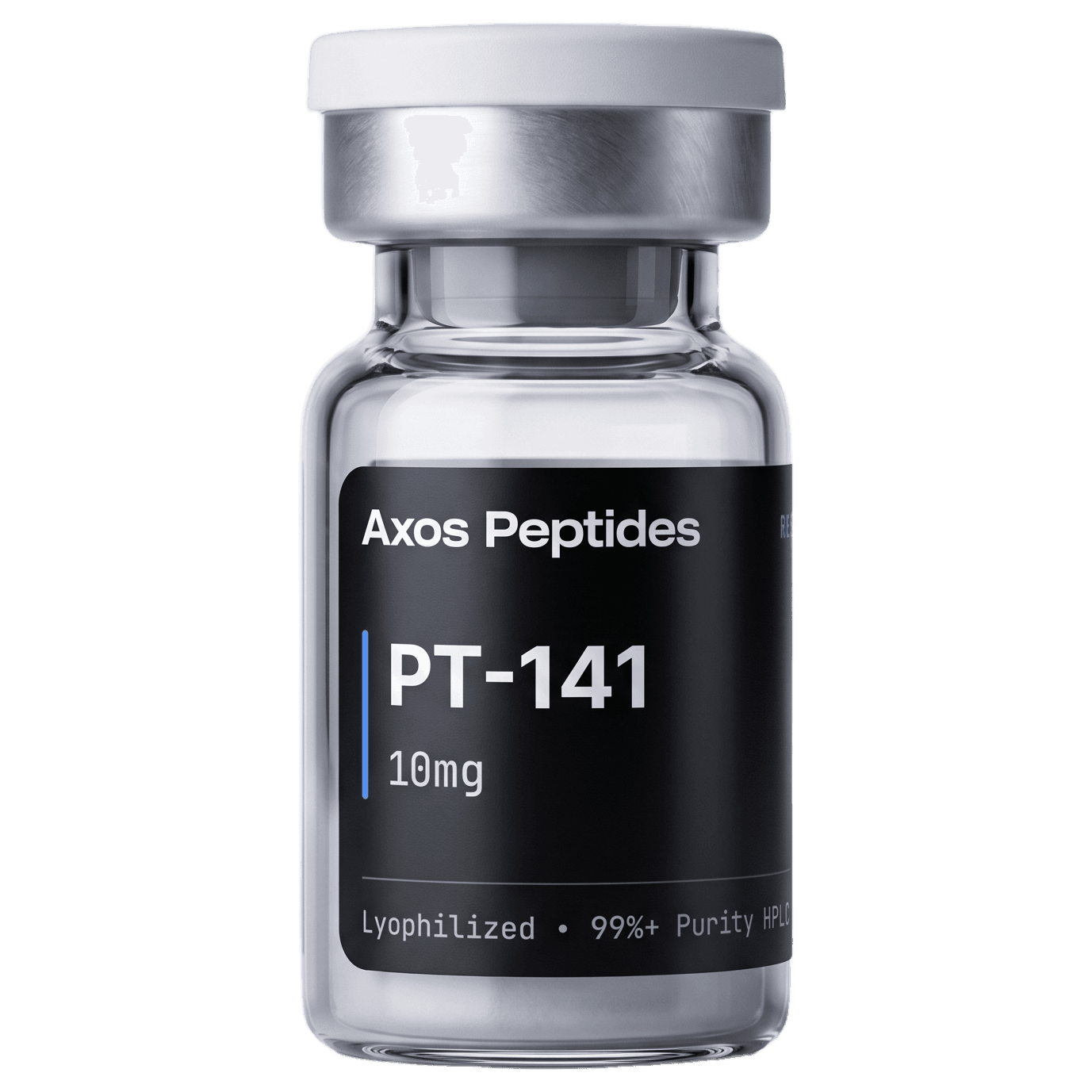
PT-141 is a lab-made copy of alpha-melanocyte-stimulating hormone, or alpha-MSH. It switches on melanocortin receptors. The two that matter here are MC3R and MC4R. Both sit mostly in the central nervous system, not in blood vessels.1
That difference is the whole reason the compound exists. The familiar erectile-dysfunction drugs are PDE5 inhibitors. They work on blood flow. PT-141 aims at the signal that comes before blood flow.1
Researchers could see it happen. In rats, PT-141 switched on neurons in the hypothalamus. They measured this as a rise in c-Fos, a marker that appears in neurons which have just fired.1
Identity
- Bremelanotide
- Also known as
- Melanocortin receptor agonist
- Class
- MC3R, MC4R
- Main receptors · Central nervous system
- alpha-MSH analogue
- Parent molecule
What the human trials measured
The early work was small. A 2006 study enrolled 18 premenopausal women diagnosed with female sexual arousal disorder. Each woman received bremelanotide in one session and placebo in another.4
The researchers measured two separate things. One was a physical signal, recorded during neutral and then erotic video. The other was what the women themselves reported. Eighteen people is a pilot, and the paper reads like one.4
The phase 3 programme was a different scale. RECONNECT was two identical trials, each randomised, double-blind and placebo-controlled. Together they enrolled 1,267 premenopausal women with hypoactive sexual desire disorder. Treatment ran 24 weeks.2
Who took part matters when reading any result. Most participants were white (85.6%). Nearly all were at United States sites (96.6%). Mean age was 39.2
The trials had two co-primary endpoints. Both were questionnaire scores. The first was the Female Sexual Function Index desire domain. The second was one item from the Female Sexual Distress Scale, covering desire, arousal and orgasm.2
Women taking bremelanotide improved from baseline on both, and the difference reached statistical significance.2 That is what the headline refers to. It is a change in reported desire and reported distress, not a count of anything physical.
Approved — for one condition, in one population
Bremelanotide is approved as Vyleesi. The approval is for hypoactive sexual desire disorder in premenopausal women. That is exactly who the phase 3 trials enrolled.2
Approvals are narrow by design. They name a condition, a group of people and a product made to a fixed specification. Read that way, an approval tells you what was proven and to whom. It does not extend past its own wording.
What the trials report about tolerability
This is the part worth reading closely. It is where the published record says the most, and where summaries say the least.
Women who finished the 24-week phase could enter a 52-week open-label extension. 856 were eligible. 684 enrolled. 272 finished.3
The most common drug-related events were nausea (40.4%), flushing (20.6%) and headache (12.0%).3
Two in five reported nausea. Fewer than half who started the extension finished it. That is a real finding, and it sits in the same paper as the efficacy result. An honest summary carries both.
| Event | Share of participants |
|---|---|
| Nausea | 40.4% |
| Flushing | 20.6% |
| Headache | 12.0% |
What the research does not establish
- The animal work measured behaviour, not experience. In female rats, PT-141 raised one specific class of behaviour and left the others alone. It did not make the animals generally more active.5 That is a precise finding about a rodent. It is not a statement about human desire.
- The early human work in men was small. A 2003 review describes increases in erectile activity in healthy men and in men with erectile dysfunction.1 No approval followed. The programme that reached phase 3 was the one in premenopausal women.2
- None of this speaks to research material. The trials tested a pharmaceutical product built to a regulated specification. A research vial is a different thing. Its identity and its purity are facts about its own lot certificate, and nothing else.
Sources
Numbered as cited in the text · how we source
- 1
PT-141: a melanocortin agonist for the treatment of sexual dysfunction
Molinoff PB, Shadiack AM, Earle D, et al. · Ann N Y Acad Sci. 2003;994:96-102 · 2003
ReviewPubMed 12851303 - 2
Bremelanotide for the Treatment of Hypoactive Sexual Desire Disorder: Two Randomized Phase 3 Trials
Kingsberg SA, Clayton AH, Portman D, et al. · Obstet Gynecol. 2019;134(5):899-908 · 2019
Phase 3PubMed 31599840 - 3
Long-Term Safety and Efficacy of Bremelanotide for Hypoactive Sexual Desire Disorder
Simon JA, Kingsberg SA, Portman D, et al. · Obstet Gynecol. 2019;134(5):909-917 · 2019
Open-labelPubMed 31599847 - 4
An effect on the subjective sexual response in premenopausal women with sexual arousal disorder by bremelanotide (PT-141), a melanocortin receptor agonist
Diamond LE, Earle DC, Heiman JR, et al. · J Sex Med. 2006;3(4):628-638 · 2006
- 5
Selective facilitation of sexual solicitation in the female rat by a melanocortin receptor agonist
Pfaus JG, Shadiack A, Van Soest T, et al. · Proc Natl Acad Sci U S A. 2004;101(27):10201-10204 · 2004
AnimalPubMed 15226502