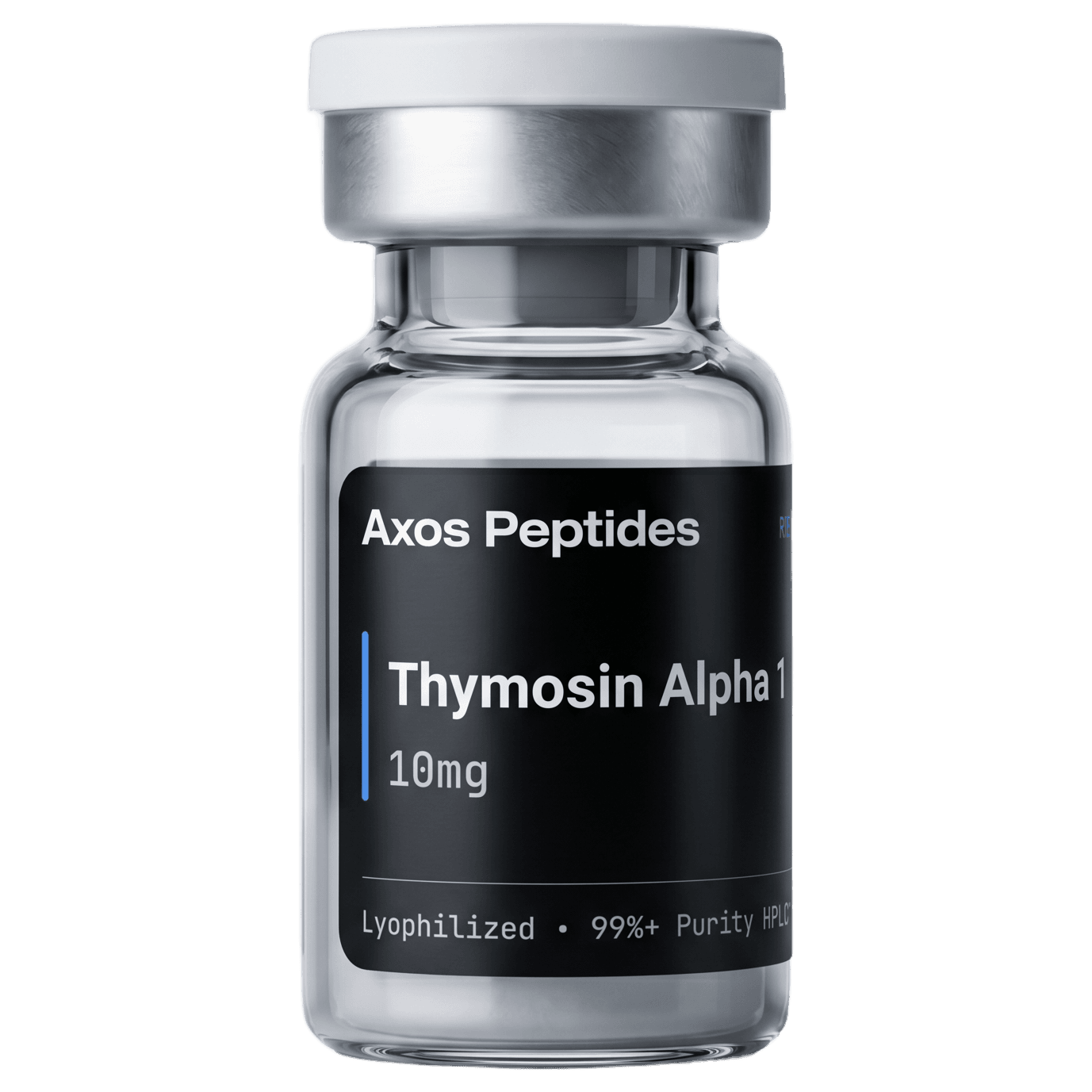
Published research on the reference compound class. Provided for scientific context only. Not a claim about the product supplied.
What it is, and what it is not
Thymosin alpha-1 is a 28-amino-acid peptide. It comes from a larger protein, prothymosin alpha. It was first described from calf thymus in 1977.1
The thymus trains T cells. It is fully active in childhood and shrinks with age. So a signalling peptide from that organ is a reasonable place to look for immune effects. That is why the compound has held interest for nearly fifty years.2
Identity
- 28 amino acids
- Length
- Prothymosin alpha
- Parent protein
- 1977
- First characterised · From calf thymus
- Thymalfasin
- Also called
What it does to immune cells
The laboratory picture is broad and reasonably consistent. Thymosin alpha-1 can:
- Enhance T-cell, dendritic-cell and antibody responses.1
- Modulate the production of cytokines and chemokines — the signalling molecules immune cells use to coordinate.1
- Block steroid-induced apoptosis of thymocytes, meaning it protects developing T cells from a specific death signal.1
- Raise expression of MHC class-1 and Toll-like receptors, which is part of how cells present threats to the immune system.2
That range explains the number of settings it has been tried in. Immunocompromised states. Malignancies. Vaccine response. Sepsis, and a long list of infections.6
Breadth is not depth. A compound with plausible effects on many pathways will generate many trials. Whether those trials found anything is a separate question. It is the one worth asking.
The sepsis trial, and why it matters most
In January 2025 the *BMJ* published TESTS, a multicentre, double-blinded, placebo-controlled phase 3 trial.3
It enrolled 1,106 adults aged 18 to 85 with sepsis, diagnosed by sepsis-3 criteria. They were randomised one to one: 552 to thymosin alpha-1, 554 to placebo.3
Randomisation was stratified by age and by centre. The modified intention-to-treat analysis covered 1,089 people.3
The primary outcome was 28-day all-cause mortality. It occurred in 127 participants (23.4%) on thymosin alpha-1. On placebo it was 132 (24.1%). The hazard ratio was 0.99, with a confidence interval from 0.77 to 1.27.3
- 1,106
- adults randomised in the phase 3 trial3
- 23.4%
- died by day 28 on thymosin alpha-13
- 24.1%
- died by day 28 on placebo3
No secondary outcome differed significantly between the groups. Neither did any safety outcome.3
The authors' conclusion is one sentence. The trial found no clear evidence that thymosin alpha-1 decreases 28-day all-cause mortality in adults with sepsis.3
Hepatitis B: what Cochrane concluded
Chronic hepatitis B is the condition most associated with this compound. In September 2026 a Cochrane systematic review assessed that evidence.4
Cochrane reviews report two things. One is an effect estimate. The other is how much confidence that estimate deserves. Both matter here.
The pooled numbers look favourable. Thymosin alpha-1 may reduce all-cause mortality, across 3 studies and 907 participants. It may also reduce serious adverse events and hepatitis-B-related mortality.4
Then comes the certainty rating. The reviewers assessed the evidence as very low certainty for every outcome except serious adverse events, which they rated low.4
Their conclusion is blunt. They are not sure whether the compound reduces all-cause mortality, serious adverse events or hepatitis-B-related mortality. They also found no ongoing trials.4
| Outcome | Studies / participants | Certainty |
|---|---|---|
| All-cause mortality | 3 / 907 | Very low |
| Serious adverse events | 5 / 1,056 | Low |
| Hepatitis-B-related mortality | 3 / 907 | Very low |
| Quality of life | 1 / 161 | Very low |
Why the picture keeps shifting
A 2025 review of sepsis trials shows how this happens. The pattern repeats across the literature, so it is worth following.
The review pooled 11 randomised trials. That was 967 patients given thymosin alpha-1 and 960 controls. Pooled together, 28-day mortality improved, at an odds ratio of 0.73.5
Then the authors re-ran it on subsets. Restricted to high-quality trials, the odds ratio moved to 0.82. It was no longer statistically significant. Restricted to multicentre trials it moved to 0.86, and again was not significant.5
That is the pattern. Smaller, single-centre trials pull the average toward benefit. The better controlled the study, the smaller the effect gets. The biggest and best controlled study of all found nothing.3
A large evidence base and a settled answer are not the same thing.
What this does and does not mean
- It does not mean the compound does nothing. It means the strongest trials did not show the benefits attributed to it, in the conditions they tested.34
- The safety record reads relatively clean. In the phase 3 trial, no safety outcome differed significantly from placebo.3 Cochrane rated the serious-adverse-event evidence low certainty rather than very low.4
- Laboratory effects are well described. The immune-cell work is the most solid part of the literature.12
- Marketing tends to cite reviews, not trials. A review describes what a compound has been used for.6 A randomised trial tests whether it worked. Those are different documents.
Sources
Numbered as cited in the text · how we source
- 1
Thymosin alpha 1: biological activities, applications and genetic engineering production
Li J, Liu CH, Wang FS · Peptides. 2010;31(11):2151-2158 · 2010
ReviewPubMed 20699109 - 2
Thymosin alpha1: a historical overview
Garaci E · Ann N Y Acad Sci. 2007;1112:14-20 · 2007
ReviewPubMed 17567941 - 3
The efficacy and safety of thymosin alpha1 for sepsis (TESTS): multicentre, double blinded, randomised, placebo controlled, phase 3 trial
Wu J, Pei F, Zhou L, et al. · BMJ. 2025;388:e082583 · 2025
Phase 3PubMed 39814420 - 4
Thymosin-alpha1 for people with chronic hepatitis B
Naing C, Ni H, Aung HH, et al. · Cochrane Database Syst Rev. 2026;9(9):CD014610 · 2026
Cochrane reviewPubMed 42713852 - 5
Efficacy of thymosin alpha1 for sepsis: a systematic review and meta-analysis of randomized controlled trials
Gu B, Zhou Y, et al. · Front Cell Infect Microbiol. 2025 · 2025
Meta-analysisPubMed 40969554 - 6
Thymosin alpha 1: A comprehensive review of the literature
Dominari A, Hathaway D III, Pandav K, et al. · World J Virol. 2020;9(5):67-78 · 2020
ReviewPubMed 33362999