Published research on the reference compound class. Provided for scientific context only. Not a claim about the product supplied.
The tail of a hormone
Alpha-MSH is a thirteen-amino-acid hormone, made from a larger protein called proopiomelanocortin. Its protective and anti-inflammatory effects are well described.3
It works in two places at once. It acts through melanocortin receptors in the brain. It also acts directly on immune cells in the body.3
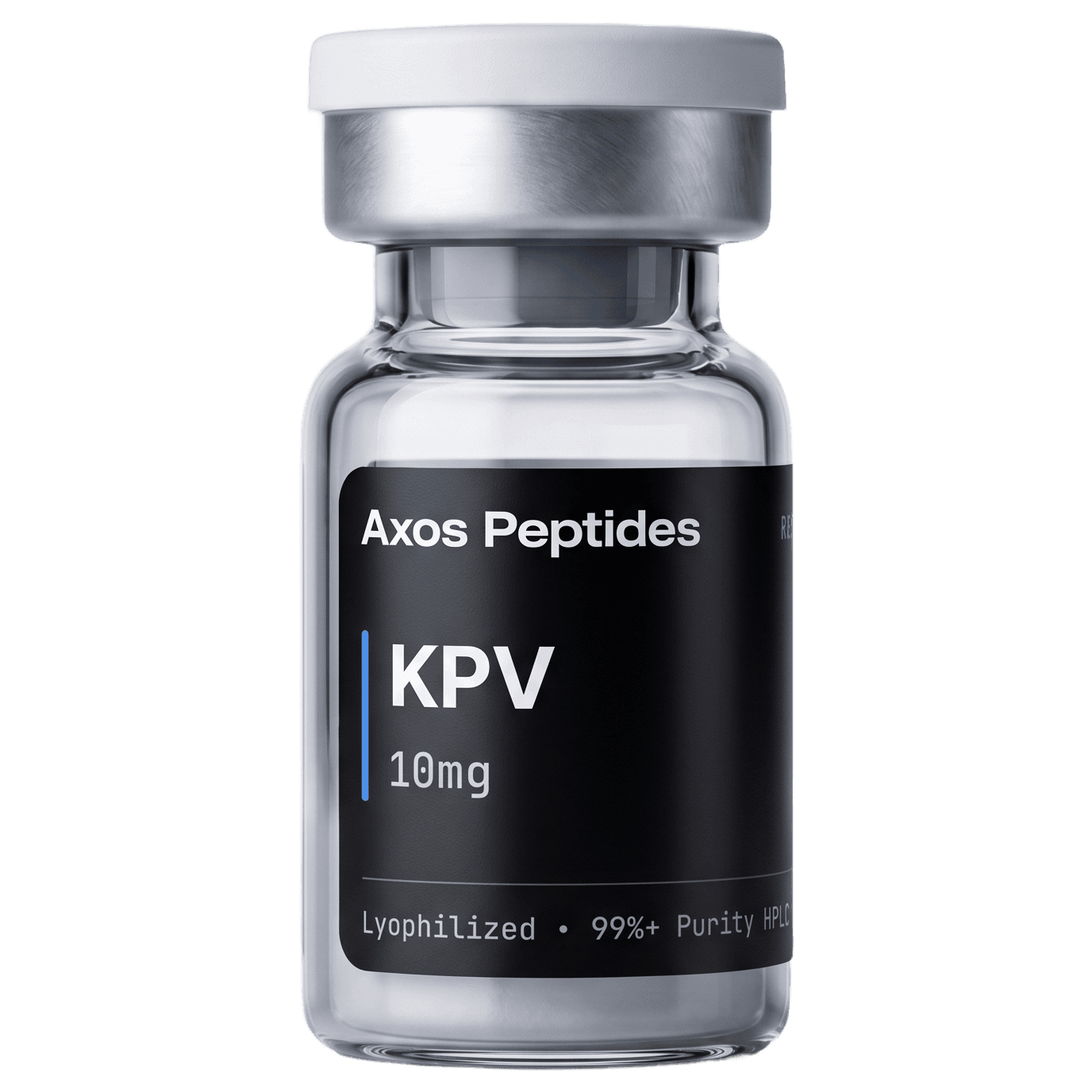
KPV is the last three amino acids of that hormone: lysine, proline, valine. Researchers write it as alpha-MSH(11-13).1
The appeal of a fragment is focus. Alpha-MSH affects many pathways at once, pigmentation among them. A three-amino-acid tail that keeps the anti-inflammatory part and drops the rest is a narrower tool.3
Identity
- Lys-Pro-Val
- Sequence
- 3 amino acids
- Length
- alpha-MSH(11-13)
- Parent hormone
- Gut inflammation models
- Studied mainly in
How it gets into cells, and why that is clever
Most of the interest in KPV rests on one mechanism finding. It is an elegant one.
PepT1 is a transporter. It carries two- and three-amino-acid peptides into cells. It normally sits in the small intestine. During inflammatory bowel disease, the colon starts expressing it too.2
Researchers tested whether KPV uses that door. They worked with human intestinal cell lines and human T cells, stimulated with inflammatory signals.2
They measured NF-kappaB activity, a central switch for inflammatory genes. They also ran uptake experiments with radiolabelled KPV, to see how it entered.2
The finding: KPV's anti-inflammatory effect is PepT1-mediated, in both intestinal epithelial cells and immune cells.2
What the animal studies report
Two papers from 2008 tested KPV in established mouse models of colitis. A 2017 paper went back to the delivery problem.
- Two chemical colitis models. KPV's anti-inflammatory effect was assessed in mice with colitis induced by DSS and by TNBS, with KPV added to the drinking water.2
- A second lab, different models. An independent group tested KPV in DSS colitis and in a transfer-colitis model. They tracked inflammation by tissue changes in the colon and by myeloperoxidase activity, a marker of inflammatory cell infiltration.1
- A receptor test. That group also used mice carrying a nonfunctional melanocortin-1 receptor, to ask whether KPV needs that receptor to work.1
- A delivery experiment. A 2017 study loaded KPV into hyaluronic-acid-functionalised nanoparticles to target it orally, reporting that this alleviated ulcerative colitis in mice.4
Two separate groups reached similar conclusions in different models. That is a stronger position than most compounds in this catalog can claim. It is still mice.
What is missing
The gap is simple to state. There is no published human trial of KPV. The literature runs from cell culture to mouse colitis, and stops.
- The models are specific. DSS and TNBS colitis are chemically induced models of gut inflammation. They are standard and useful. They are not human inflammatory bowel disease.21
- Delivery is an unsolved problem, not a solved one. The nanoparticle study exists precisely because getting a tripeptide to the right place orally is difficult.4
- Claims beyond the gut are thinner. The strongest KPV work is intestinal. Broader claims lean on the parent hormone's literature instead of KPV's own.3
- One reassuring note, stated for what it is. A 2017 paper describes KPV as a naturally occurring tripeptide without notable toxicity.4 That is an author's description inside a delivery study. It is not a safety trial.
KPV is also one of the four parts of the KLOW blend. The same evidence applies there. That comparison is covered separately.
Sources
Numbered as cited in the text · how we source
- 1
Melanocortin-derived tripeptide KPV has anti-inflammatory potential in murine models of inflammatory bowel disease
Kannengiesser K, Maaser C, Heidemann J, et al. · Inflamm Bowel Dis. 2008;14(3):324-331 · 2008
AnimalPubMed 18092346 - 2
PepT1-mediated tripeptide KPV uptake reduces intestinal inflammation
Dalmasso G, Charrier-Hisamuddin L, Nguyen HT, et al. · Gastroenterology. 2008;134(1):166-178 · 2008
Animal / in vitroPubMed 18061177 - 3
Alpha-melanocyte-stimulating hormone and related tripeptides: biochemistry, antiinflammatory and protective effects in vitro and in vivo
Brzoska T, Luger TA, Maaser C, et al. · Endocr Rev. 2008;29(5):581-602 · 2008
ReviewPubMed 18612139 - 4
Orally Targeted Delivery of Tripeptide KPV via Hyaluronic Acid-Functionalized Nanoparticles Efficiently Alleviates Ulcerative Colitis
Xiao B, Xu Z, Viennois E, et al. · Mol Ther. 2017;25(7):1628-1640 · 2017
AnimalPubMed 28143741