Published research on the reference compound class. Provided for scientific context only. Not a claim about the product supplied.
Two molecules, one code
Most naming confusion in research peptides is cosmetic. This one is not.
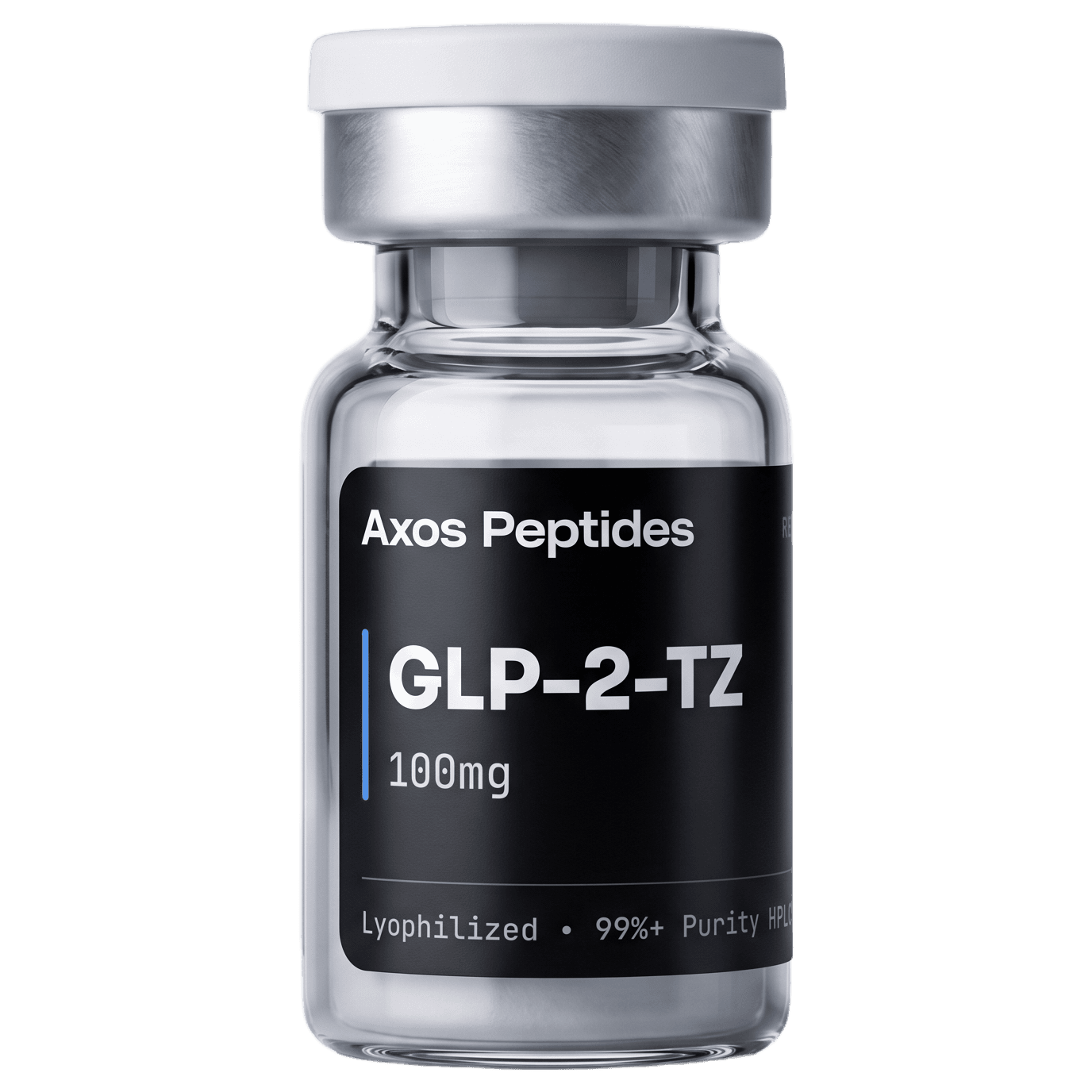
Search GLP-2 TZ and you will find two kinds of listing. Most suppliers, including this one, describe a 39-amino-acid dual GIP and GLP-1 receptor agonist. At least one describes a 33-amino-acid analogue of glucagon-like peptide-2.2
Those are not two grades of the same thing. They act on different receptors, in different tissues, for different reasons. A reader comparing prices across suppliers may be comparing two unrelated compounds.
What GLP-2 TZ is in this catalog
The compound supplied here is a dual agonist. It activates two receptors at once: the GIP receptor and the GLP-1 receptor.1
Both are receptors for incretins — gut hormones released after a meal that work together to prompt insulin release.3 GLP-1 is the familiar one. GIP, glucose-dependent insulinotropic polypeptide, is the other.
The reference compound was built to test a specific question: whether adding GIP activity improves on what selective GLP-1 receptor agonists already achieve in type 2 diabetes.1 Structurally it is a fatty-acid-modified peptide, designed for once-weekly administration.1
In its phase 3 programme, the reference compound was tested as a single agent against placebo over 40 weeks, in people with type 2 diabetes not adequately controlled by diet and exercise alone.4
Identity
- 39 amino acids
- Length
- GIP + GLP-1 receptors
- Targets
- Dual incretin agonist
- Class
- Fatty-acid modified
- Modification
What glucagon-like peptide-2 actually is
This is the molecule the name points at, and it is worth describing properly, because it is a real and well-studied hormone.
Glucagon-like peptide-2 is a 33-amino-acid gut peptide. It comes from the glucagon gene, expressed in the L-cells of the intestinal lining, and it is released mainly when unabsorbed nutrients reach the gut.2
Its job is growth. GLP-2 is described as intestinotrophic: it drives mucosal growth, increases the activity of several brush-border enzymes, and slows gastric transit. The combined effect is more capacity to absorb nutrients.2 It plays a significant part in the adaptive regulation of bowel mass and mucosal integrity.5
That is why a long-acting GLP-2 analogue became a medicine. In short bowel syndrome, where too little intestine remains to absorb enough, such an analogue improves fluid absorption and has been shown to reduce dependence on intravenous feeding.6
Why the distinction is not academic
Two compounds with different targets have different properties, and the published literature on one says nothing about the other.
One example makes the point. Because glucagon-like peptide-2 promotes intestinal growth, researchers asked whether it might also promote the growth of tissue that should not be growing. In a study of 210 mice with chemically induced colonic tumours, treatment with GLP-2 was examined for exactly that.7
The authors state the concern plainly at the outset: growth stimulation of the intestinal system may accelerate the growth of existing neoplasms in the intestine.7 That is a consideration specific to an intestinal growth factor. It has no bearing on a dual incretin agonist, which is not one.
The reverse holds too. Trial results for a dual GIP and GLP-1 agonist say nothing about what a GLP-2 analogue does.4 Anyone citing one body of evidence for the other is citing the wrong compound — the same error this library documents for epithalon and TB-500.
What settles it
A product name is a marketing decision. A certificate is a measurement.
Identity testing on a lot report establishes which molecule is present, by mass. A 39-amino-acid peptide and a 33-amino-acid peptide have plainly different masses, so the two cannot be confused once the report is read.
- Read the identity line, not just the purity figure. Purity tells you how much of the vial is the stated compound. Identity tells you what the stated compound is.
- Compare like with like across suppliers. If two listings share a code but not an amino-acid count, they are different products.
- Check the lot, not the range. Every lot is tested separately, and the certificate refers to one of them.
Every lot released here is tested by an outside laboratory before sale, and the report is published. The GLP-2 TZ lab reports page carries them, and how to read one is covered separately.
Sources
Numbered as cited in the text · how we source
- 1
[Reference compound], a novel dual GIP and GLP-1 receptor agonist for the treatment of type 2 diabetes mellitus: from discovery to clinical proof of concept
Coskun T, Sloop KW, Loghin C, et al. · Mol Metab. 2018;18:3-14 · 2018
DiscoveryPubMed 30473097 - 2
Glucagon-like peptide 2 (GLP-2), an intestinotrophic mediator
Thulesen J · Curr Protein Pept Sci. 2004;5(1):51-65 · 2004
ReviewPubMed 14965320 - 3
The Effects of Dual GLP-1/GIP Receptor Agonism on Glucagon Secretion - A Review
Mathiesen DS, Bagger JI, Bergmann NC, et al. · Int J Mol Sci. 2019;20(17):4092 · 2019
ReviewPubMed 31443356 - 4
Efficacy and safety of a novel dual GIP and GLP-1 receptor agonist [reference compound] in patients with type 2 diabetes (SURPASS-1): a double-blind, randomised, phase 3 trial
Rosenstock J, Wysham C, Frias JP, et al. · Lancet. 2021;398(10295):143-155 · 2021
Phase 3PubMed 34186022 - 5
Glucagon-like Peptide-2
Estall JL, Drucker DJ · Annu Rev Nutr. 2006;26:391-411 · 2006
ReviewPubMed 16602931 - 6
Short bowel syndrome: the role of GLP-2 on improving outcome
Wallis K, Walters JR, Gabe S · Curr Opin Clin Nutr Metab Care. 2009;12(5):526-532 · 2009
ReviewPubMed 19474717 - 7
Glucagon-like peptide 2 (GLP-2) accelerates the growth of colonic neoplasms in mice
Thulesen J, Hartmann B, Hare KJ, et al. · Gut. 2004;53(8):1145-1150 · 2004
AnimalPubMed 15247183