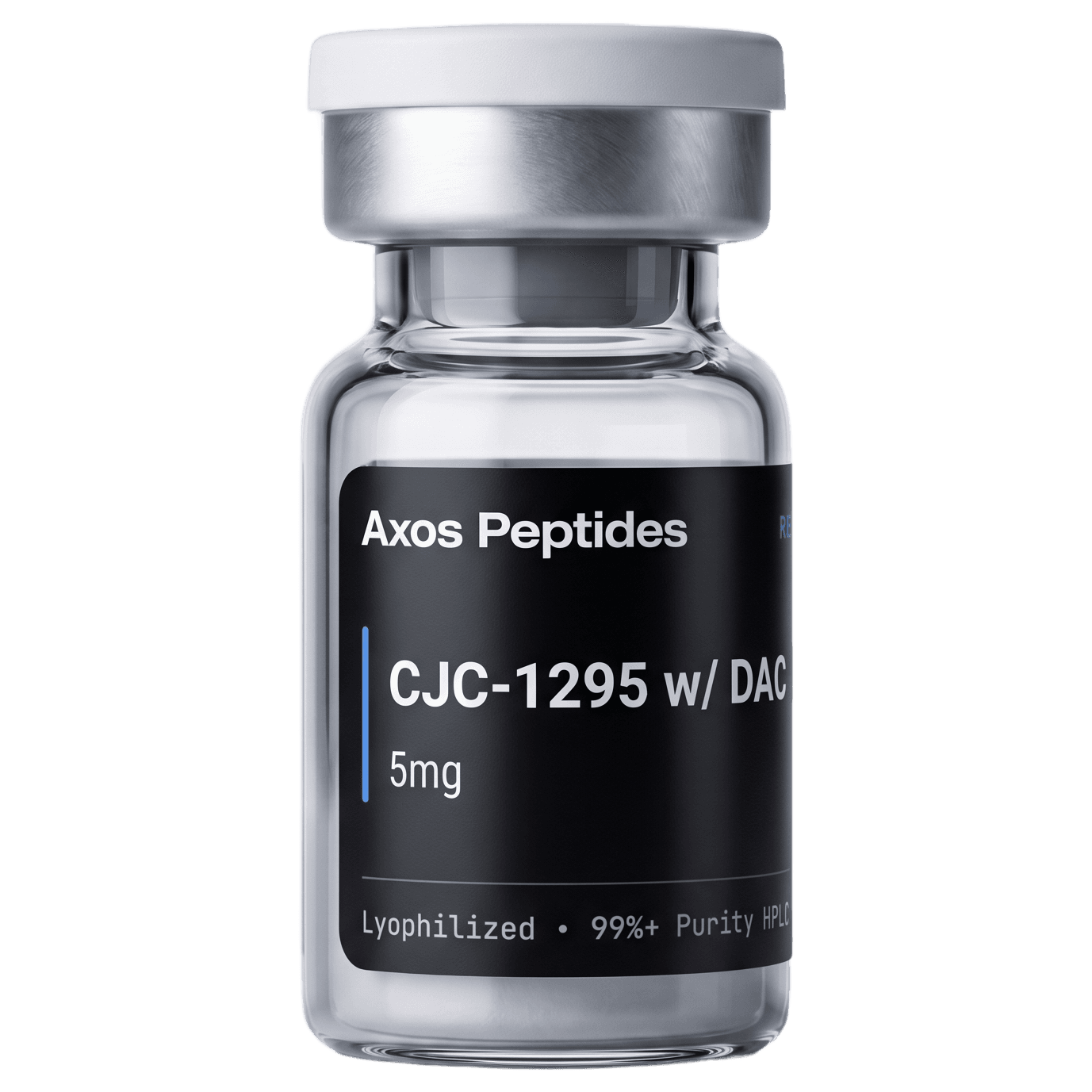
Published research on the reference compound class. Provided for scientific context only. Not a claim about the product supplied.
The growth-hormone system in 60 seconds
Growth hormone isn't released in a steady stream. The pituitary, a pea-sized gland at the base of the brain, releases it in pulses. The liver answers by making IGF-1, the hormone behind many of GH's effects.
Two separate 'go' signals drive those pulses:
- GHRH (growth hormone-releasing hormone), which works through the GHRH receptor. CJC-1295 is a lab-built version of this signal.3
- Ghrelin, the so-called hunger hormone, which works through a different receptor. Ipamorelin mimics this signal.2
Because the two peptides use different receptors, researchers study them together to see how the signals interact. In human research, combining a GHRH-type peptide with a ghrelin-receptor peptide produced an additive GH response. With repeated administration, that response could turn synergistic, bigger than the sum of its parts.4
CJC-1295: the long-lasting GHRH signal
Natural GHRH acts only briefly, which has long limited its usefulness.1 CJC-1295 changes that in two ways. First, it's a modified version of GHRH's first 29 amino acids, with four amino-acid substitutions. Second, the original design adds a reactive linker, known as DAC, that bonds to albumin, the most common protein in blood. Bonded to albumin, the peptide held up better against the enzyme that normally breaks it down.3
That albumin anchor is what stretches its lifespan. In rats, CJC-1295 produced four times more GH than plain GHRH(1-29) over two hours, and it was still in the blood after 72 hours.3
The best-known human data comes from the DAC version. In two placebo-controlled trials in healthy adults aged 21 to 61, a single study dose raised average GH levels 2- to 10-fold for six days or more, and IGF-1 1.5- to 3-fold for 9 to 11 days. With repeated administration, IGF-1 stayed above baseline for up to 28 days. No serious adverse reactions were reported.1
A second study asked a smart question: does a long-acting signal flatten the body's natural pulses? It didn't. GH still came in pulses of the same size and frequency, while the baseline between pulses rose 7.5-fold. That lifted average GH by 46% and IGF-1 by 45%.5
Ipamorelin: the selective one
Ipamorelin is a five-amino-acid peptide from a family called GH secretagogues: molecules that trigger GH release. Its claim to fame is selectivity. Older relatives such as GHRP-6 and GHRP-2 also raised the stress hormones ACTH and cortisol. In animal studies, ipamorelin didn't, even at levels more than 200 times what it took to release GH. It also left other pituitary hormones (FSH, LH, prolactin and TSH) alone. Its developers called it the first selective growth hormone secretagogue.2
In healthy volunteers, ipamorelin produced a single GH pulse that peaked about 40 minutes after administration, and it had a half-life of about two hours.6 In rats, 15 days of ipamorelin sped up bone growth in a dose-dependent way, from 42 to 52 micrometres per day.7
Why pair them?
The logic is simple: two different receptors, one output. CJC-1295 supplies a stronger GHRH signal. Ipamorelin adds a clean pulse through the ghrelin receptor, without the stress-hormone side trip of older secretagogues.2 Human research on GHRH plus ghrelin-receptor peptides found the combined response can be additive, and even synergistic with repeated administration.4
What's in our vial
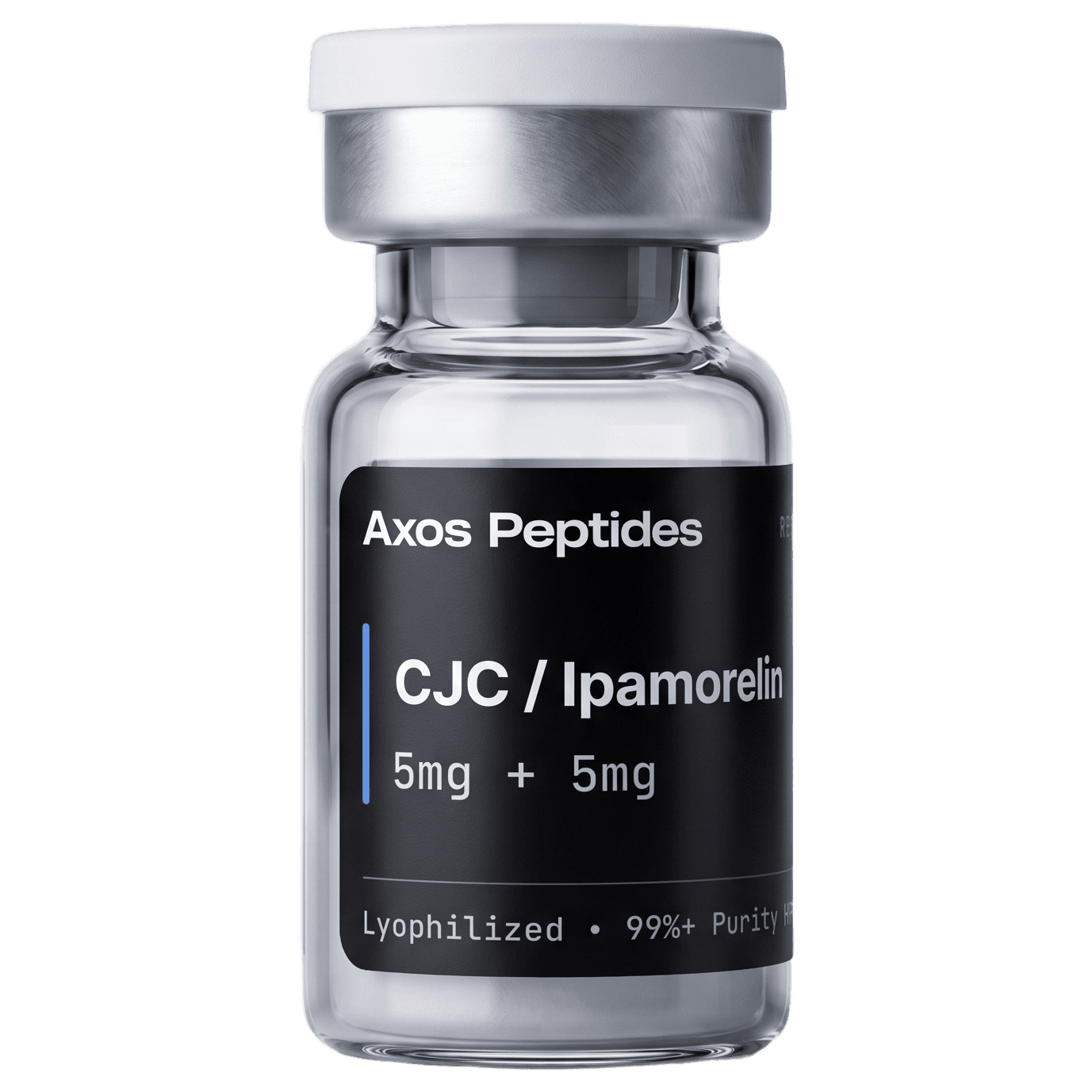
Our CJC / Ipamorelin blend pairs 5 mg of CJC-1295 without DAC with 5 mg of ipamorelin per vial, as stated on each lot's certificate. Read the current lot report in the CJC / Ipamorelin lab reports.
Want to study the halves separately? CJC-1295 with DAC, CJC-1295 without DAC and ipamorelin are each available on their own.
Sources
Numbered as cited in the text
- 1
Prolonged stimulation of growth hormone (GH) and insulin-like growth factor I secretion by CJC-1295, a long-acting analog of GH-releasing hormone, in healthy adults
Teichman SL, Neale A, Lawrence B, et al. · Journal of Clinical Endocrinology & Metabolism 91(3):799–805 · 2006
- 2
Ipamorelin, the first selective growth hormone secretagogue
Raun K, Hansen BS, Johansen NL, et al. · European Journal of Endocrinology 139(5):552–561 · 1998
- 3
Human growth hormone-releasing factor (hGRF)1-29-albumin bioconjugates activate the GRF receptor on the anterior pituitary in rats: identification of CJC-1295 as a long-lasting GRF analog
Jetté L, Léger R, Thibaudeau K, et al. · Endocrinology 146(7):3052–3058 · 2005
- 4
GHRP-2, GHRH and SRIF interrelationships during chronic administration of GHRP-2 to humans
Bowers CY, Granda-Ayala R · Journal of Pediatric Endocrinology & Metabolism 9(Suppl 3):261–270 · 1996
Human studyPubMed 8887169 - 5
Pulsatile secretion of growth hormone (GH) persists during continuous stimulation by CJC-1295, a long-acting GH-releasing hormone analog
Ionescu M, Frohman LA · Journal of Clinical Endocrinology & Metabolism 91(12):4792–4797 · 2006
- 6
Pharmacokinetic-pharmacodynamic modeling of ipamorelin, a growth hormone releasing peptide, in human volunteers
Gobburu JV, Agersø H, Jusko WJ, et al. · Pharmaceutical Research 16(9):1412–1416 · 1999
- 7
Ipamorelin, a new growth-hormone-releasing peptide, induces longitudinal bone growth in rats
Johansen PB, Nowak J, Skjaerbaek C, et al. · Growth Hormone & IGF Research 9(2):106–113 · 1999