Published research on the reference compound class. Provided for scientific context only. Not a claim about the product supplied.
The short version
- What it is: a lab-made chain of 15 amino acids, copied from a protein found in human gastric juice 3.
- Why people talk about it: in rats, it helped a fully cut Achilles tendon heal back to full integrity 1, improved healing of a cut knee ligament over 90 days 2, and sped up repair in gut and skin injury models 45.
- The catch: almost all of it is rat and cell work, and it comes from a handful of research groups — mostly one team in Zagreb, Croatia 8.
- Our part: every batch is tested by an outside lab before it goes on sale, and the report is public.
What is BPC-157?
BPC stands for “body protection compound.” That's the name a team at the University of Zagreb gave to a protein they found in human gastric juice. BPC-157 is a 15-amino-acid piece of it, built in a lab one amino acid at a time 3.
Its sequence is GEPPPGKPADDAGLV, and its molecular weight is about 1,419 — small, as peptides go 1.
Here's what makes it unusual. Most peptides get shredded in the stomach. BPC-157 is described as stable in human gastric juice 6. That's why papers call it a “stable gastric pentadecapeptide” — science-speak for “a 15-amino-acid peptide from the stomach that doesn't fall apart.”
It even went into early clinical trials for inflammatory bowel disease under the code name PL 14736 12. It never became an approved medicine.
What did the studies find?
Here are the headline results. Every one of them comes from animals or from cells in a dish.
- Tendons. Rats with a completely cut Achilles tendon healed poorly on their own. With BPC-157, their tendons were stronger under load, the rats walked better, and the tendon eventually regained its full integrity 1.
- Ligaments. After the knee's medial collateral ligament was cut, BPC-157 rats showed better function, strength and tissue quality, tracked for 90 days 2.
- Tendon cells. In the dish, tendon cells exposed to BPC-157 grew out faster, survived stress better and moved more — the basic moves of repair 3.
- Gut. The Zagreb team reports it worked consistently across their injury models of the esophagus, stomach and intestines 4.
- Skin. Their 2021 review covers faster healing of cuts, deep burns and diabetic ulcers in rats 5.
- Spinal cord. This is the one that stops people mid-scroll: rats whose tails were paralysed by a crushed spinal cord all regained tail movement, with spasticity gone by day 15 — and the team followed them for a full year 11.
How is BPC-157 supposed to work?
Healing needs three things: fresh blood supply, cells that crawl into the gap, and cells that survive long enough to rebuild. BPC-157 research touches all three.
- Cell movement. In tendon cells, it switched on a cell-migration pathway called FAK–paxillin 3.
- Blood vessels. Reviews describe it as a strong influence on how blood vessels respond and regrow after an injury 7.
- Nitric oxide. It interacts with the nitric-oxide system, the signal that tells blood vessels to relax and open up 6.
What BPC-157 hasn't proven yet
This is the part most sites skip. A 2019 review from Loughborough University in the UK, outside the Zagreb group, found the results consistently positive. But it also noted that most studies were in small rodents, that the effect is yet to be confirmed in humans, and that only a handful of research groups have studied it in depth 8.
Independent teams are starting to check. In a 2026 rat study from Istanbul, BPC-157 trended toward better tendon repair at four weeks, but unlike TB-500 in the same study, its overall scores didn't reach statistical significance 9. A 2026 sports-medicine review adds that rigorous human safety data are still scarce 10.
BPC-157 isn't an approved medicine anywhere. That's why it's sold for laboratory research only — and why we'll never tell you how to use it in a person.
Why the vial matters as much as the molecule
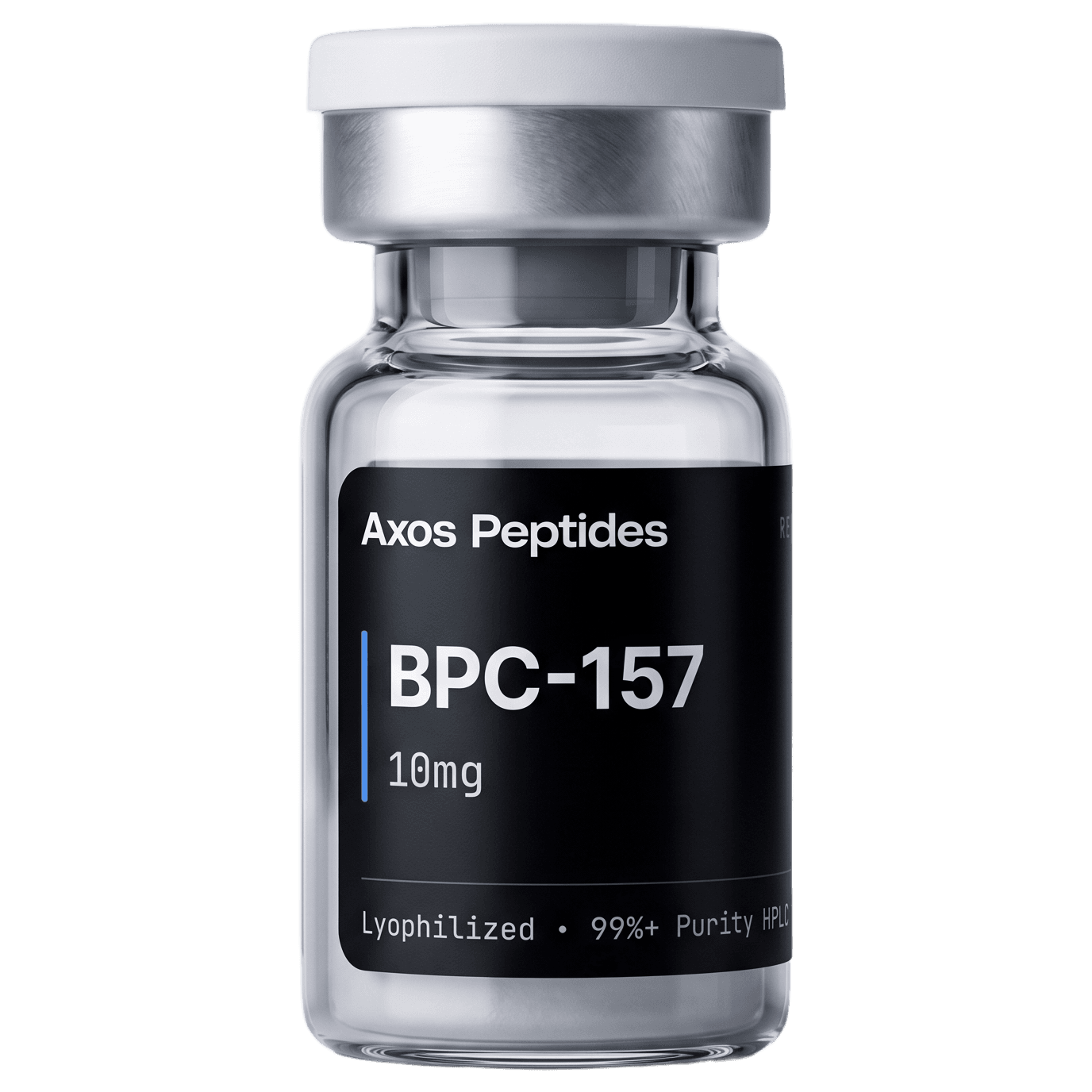
A study tells you what a molecule might do. It tells you nothing about what's actually in the vial on your bench. So before any batch of BPC-157 goes on sale, an outside lab — not us — runs two tests:
- Purity by HPLC. The certificate shows the exact number the lab measured, to two decimal places. Never “99%+.”
- Identity by mass spectrometry. The molecule's measured mass has to match BPC-157. If it doesn't, it isn't BPC-157.
The signed report goes live before the buy button works, and the lot number on your vial matches the one on the report.
Every BPC-157 batch we've released is on the BPC-157 lab-reports page, with its signed certificate. If a vial doesn't match its report, test it at any lab you like and we'll refund it in full.
The bottom line on BPC-157
BPC-157 is one of the most interesting molecules in repair research: tough enough to survive stomach acid, and linked to faster healing across a long list of rat models. It's also a molecule where the hype runs ahead of the human evidence. If you're studying it, start with a vial you can verify.
Sources
Numbered as cited in the text
- 1
Gastric pentadecapeptide BPC 157 accelerates healing of transected rat Achilles tendon and in vitro stimulates tendocytes growth
Journal of Orthopaedic Research, 2003
- 2
Pentadecapeptide BPC 157 (PL 14736) improves ligament healing in the rat
Journal of Orthopaedic Research, 2010
- 3
The promoting effect of pentadecapeptide BPC 157 on tendon healing involves tendon outgrowth, cell survival, and cell migration
Journal of Applied Physiology, 2011
- 4
BPC 157 and standard angiogenic growth factors. Gastrointestinal tract healing, lessons from tendon, ligament, muscle and bone healing
Current Pharmaceutical Design, 2018
- 5
- 6
- 7
- 8
Gastric pentadecapeptide body protection compound BPC 157 and its role in accelerating musculoskeletal soft tissue healing
Cell and Tissue Research, 2019
- 9
Effects of BPC-157 and TB-500 on Achilles tendon healing in rats: a histopathological and biomechanical study
Joint Diseases and Related Surgery, 2026
- 10
Safety and efficacy of approved and unapproved peptide therapies for musculoskeletal injuries and athletic performance
Sports Medicine, 2026
- 11
Stable gastric pentadecapeptide BPC 157 can improve the healing course of spinal cord injury and lead to functional recovery in rats
Journal of Orthopaedic Surgery and Research, 2019