Published research on the reference compound class. Provided for scientific context only. Not a claim about the product supplied.
First, the thing most listings get wrong
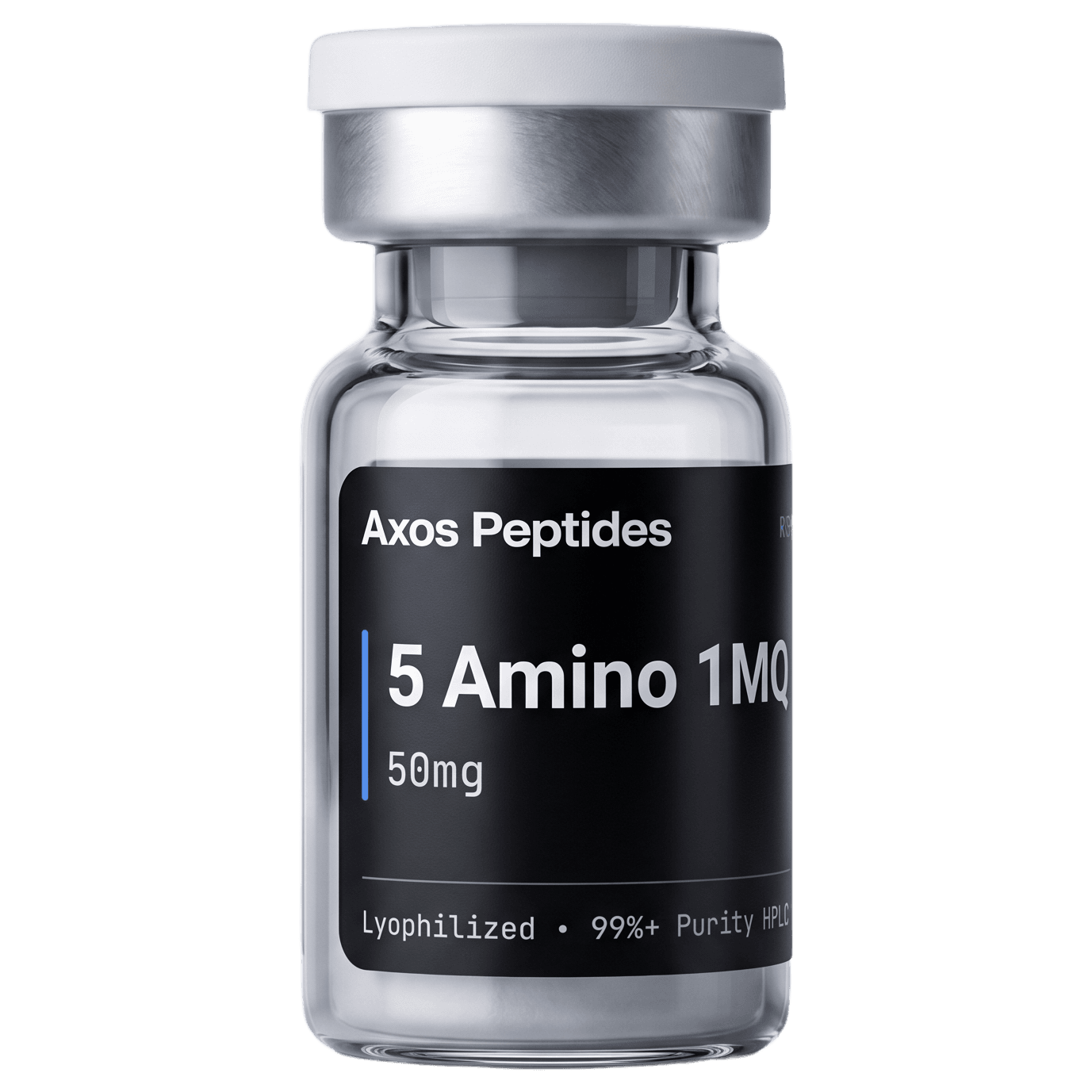
5-Amino-1MQ is a small molecule, not a peptide. Peptides are short chains of amino acids. This is a single compound with a ring structure.1
It shows up in peptide catalogues anyway. That is because the research communities overlap, not because the chemistry does.
The difference matters when you read a certificate. A peptide is confirmed by mass spectrometry against the weight expected for a known sequence. A small molecule is confirmed as a defined chemical instead.1
There is a second wrinkle. This compound is usually supplied as a salt, and a salt is a different chemical record from the bare form. If the certificate names a salt, that is what is in the vial.
What NNMT does, and why anyone cares
Cells use SAM as their universal methyl donor. Almost every methylation reaction draws on it. NNMT takes a methyl group from SAM and attaches it to nicotinamide.2
The product is 1-methylnicotinamide. It is stable, and it is not easily recycled.2
Researchers studying cancer cells put it plainly. NNMT impairs the methylation potential of the cell. It does this by spending methyl units to build a product the cell cannot reuse.2
The knock-on effect was visible in the cells. Histones came out under-methylated, and the pattern of gene activity shifted with them.2
- A methyl group leaves SAM. That is the currency cells spend on methylation.2
- Nicotinamide gets tagged. Nicotinamide feeds the NAD+ salvage route. Tagging it takes it out of circulation.2
- The product builds up. 1-methylnicotinamide is stable. The methyl units do not come back, so the process drains rather than recycles.2
What the studies report
The case for NNMT as a target was built in two steps. 5-Amino-1MQ belongs to the second one.
Step one: take the enzyme away. In 2014, a paper in *Nature* reported that NNMT knockdown protected mice against diet-induced obesity.3 That points at the target. But knocking a gene down is not a treatment.
Step two: block it with a molecule. A 2018 paper described a series of selective, membrane-permeable NNMT inhibitors. This is the class 5-Amino-1MQ belongs to. In mice, they reversed obesity caused by a high-fat diet.1
The paper checked two things that matter. Could the molecules cross a membrane? That was tested in artificial-membrane and Caco-2 cell assays. Did they hit only their target? Selectivity was tested against related methyltransferases and against enzymes in the NAD+ salvage route.1
The most striking recent result has nothing to do with adipose tissue. It is about muscle. Researchers treated aged mice, 22 to 24 months old. At that age mouse muscle shows the hallmarks of sarcopenia.4
Treated sedentary mice showed about 40% greater grip strength than sedentary controls. Exercised mice gained about 20%. The two effects added together: treated mice that also exercised reached about 60%.4
The NAD+ connection, stated carefully
5-Amino-1MQ and NAD+ come up together constantly. The link is real, and it is indirect. NNMT methylates nicotinamide, which feeds the NAD+ salvage route. Tag the precursor and that route loses it.2
What the published work shows is the enzyme chemistry and the mouse result. Claims about human NAD+ levels are not in these papers, and neither are the outcomes people attach to them. The NAD+ side of the story has its own page.
What is still unknown
- No published human trial. Every result above is mouse or cell work. Nothing here has been shown in people.
- The muscle result is in old animals. The aged-mouse model was picked because it reproduces hallmarks of sarcopenia. That is why the finding is interesting. It is not evidence that it transfers to people.4
- NNMT does more than metabolism. The methylation-sink work came out of cancer biology. NNMT is overexpressed in a range of human tumours.2 A target with several roles needs more evidence, not less.
- Identity is a per-lot question. Check the form named on your certificate. Read it next to the purity figure, not instead of it.
Sources
Numbered as cited in the text · how we source
- 1
Selective and membrane-permeable small molecule inhibitors of nicotinamide N-methyltransferase reverse high fat diet-induced obesity in mice
Neelakantan H, Vance V, Wetzel MD, et al. · Biochem Pharmacol. 2018;147:141-152 · 2018
AnimalPubMed 29155147 - 2
NNMT promotes epigenetic remodeling in cancer by creating a metabolic methylation sink
Ulanovskaya OA, Zuhl AM, Cravatt BF · Nat Chem Biol. 2013;9(5):300-306 · 2013
In vitroPubMed 23455543 - 3
Nicotinamide N-methyltransferase knockdown protects against diet-induced obesity
Kraus D, Yang Q, Kong D, et al. · Nature. 2014;508(7495):258-262 · 2014
AnimalPubMed 24717514 - 4
Nicotinamide N-methyltransferase inhibition mimics and boosts exercise-mediated improvements in muscle function in aged mice
Dimet-Wiley AL, Latham CM, Brightwell CR, et al. · Sci Rep. 2024;14(1):15554 · 2024
AnimalPubMed 38969654