Published research on the reference compound class. Provided for scientific context only. Not a claim about the product supplied.
Two different doors into the same system
The pituitary releases growth hormone on more than one signal. GHRH is the main one telling it to go.1 A second receptor gives an independent push. The growth-hormone-releasing peptides work on that one.2
So a compound can knock on either door. Which door it knocks on is the first thing that separates these three.
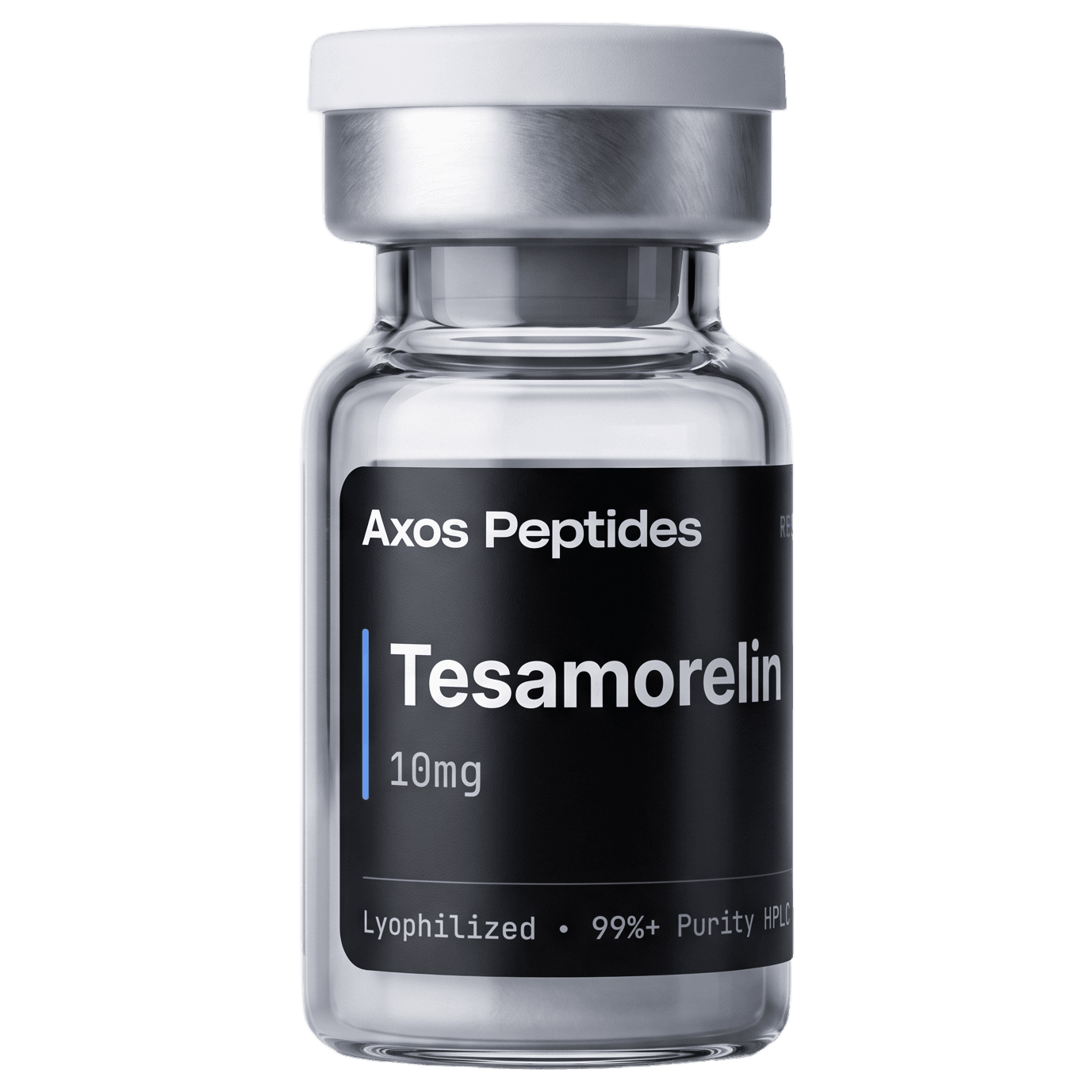
- Tesamorelin copies GHRH(1-44), the full-length hormone.4
- Sermorelin is a 29-amino-acid copy of GHRH. It is the shortest synthetic fragment that keeps the hormone's full activity.1
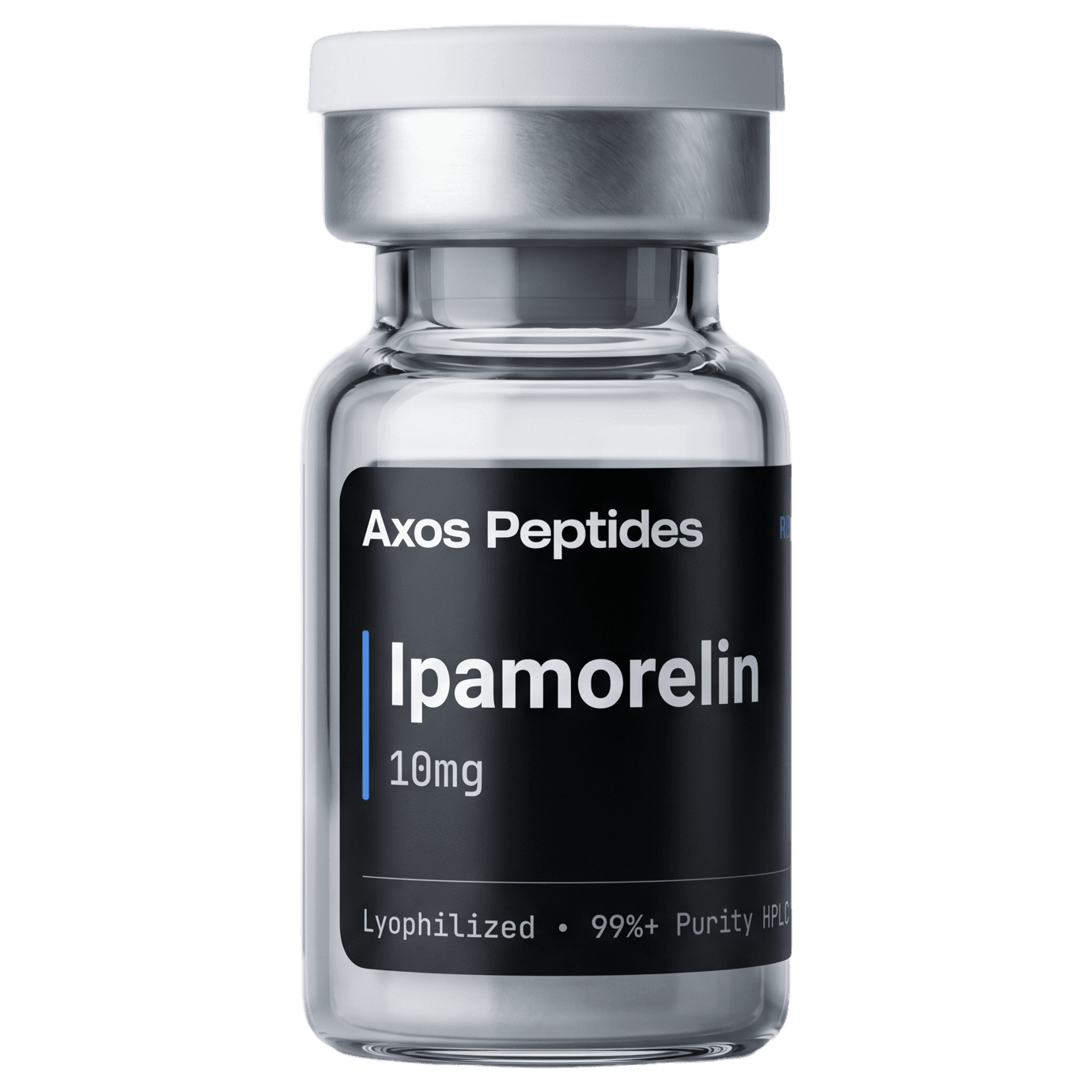
- Ipamorelin is a five-amino-acid peptide. It acts on a GHRP-like receptor, not the GHRH one. Blocking studies showed this directly.2
| Compound | Class | Largest published human evidence | What it measured |
|---|---|---|---|
| Tesamorelin | GHRH(1-44) analogue | 806 patients, pooled phase 34 | Visceral adipose tissue by CT |
| Sermorelin | GHRH(1-29) analogue | Review of diagnostic and paediatric use1 | Growth hormone response; growth in children |
| Ipamorelin | Pentapeptide, GHRP-like receptor | None comparable | Animal and cell pharmacology2 |
Tesamorelin: the one with the trials
Tesamorelin is the only one of the three with large randomised trials that measured the outcome by scan. Every one of those trials ran in the same population: people with HIV who had gained abdominal fat on antiretroviral therapy.3
That context is part of the finding. It is not a footnote to it.
The 2007 trial randomised 412 patients, 86% of them men, for 26 weeks. Visceral adipose tissue was measured by CT scan. It fell 15.2% on tesamorelin and rose 5.0% on placebo.3
Blood lipids moved too. Triglycerides fell by 50 mg per decilitre on tesamorelin and rose by 9 mg per decilitre on placebo.3
A pooled analysis put two phase 3 studies together: 806 patients, randomised two to one, with a 26-week placebo-controlled phase and a 26-week safety extension. At week 26 the treatment effect on visceral adipose tissue was -15.4%.4
A separate 12-month trial in 404 patients reported a fall of 10.9%.5 Three trials, three figures in the same range.
Two later trials looked past fat distribution to the liver. A 2014 randomised trial in 50 patients measured visceral fat and liver fat together.6 A 2019 randomised, double-blind, multicentre trial looked at non-alcoholic fatty liver disease in people with HIV.7
Muscle was looked at once, in a secondary analysis of two completed trials. Researchers measured trunk muscle density and area on CT scans at L4-L5.8
One detail limits it. The analysis was restricted to responders, meaning participants whose visceral adipose tissue fell by 8% or more. It describes a selected group, not everyone treated.8
Sermorelin: a diagnostic tool first
Sermorelin's published record looks different from the picture it gets in comparison articles. Its best-documented role is diagnostic.1
The growth hormone response to sermorelin is a rapid and fairly specific test for growth hormone deficiency. In children who do not have the deficiency, it produced fewer false positives than other tests of the same kind.1
As a treatment, the same review reports limited data, in some prepubertal children with idiopathic growth hormone deficiency.1
The adult literature is thinner still. The adult paper most often cited runs to two pages, and it is a commentary rather than a trial.9
We do not carry sermorelin. It appears here because it is the comparison people search for, and the honest answer has to say what its evidence actually covers.
Ipamorelin: selectivity, demonstrated in animals
Ipamorelin arrived in 1998, described as the first selective growth hormone secretagogue. It is a five-amino-acid peptide. Chemists found it by stripping the central pair of amino acids out of an earlier growth-hormone-releasing peptide.2
The defining paper is animal and cell work, and it is thorough. Ipamorelin released growth hormone from rat pituitary cells, matching GHRP-6 for both potency and effect.2
Blocking experiments then showed which receptor it used. It works through a GHRP-like receptor, not the GHRH one. It also released growth hormone in rats and in conscious swine, again on a par with GHRP-6.2
The word doing the work is selective. The older comparison compound moved other pituitary hormones too. Ipamorelin released growth hormone without that spillover.2
That is a real pharmacological finding. It is also a finding in rats, swine and cells. No human trial of comparable weight has been published.
What none of the three establishes
- No head-to-head trial exists. No published study randomised people between these three. Any ranking is pieced together from separate trials in different groups.
- Combinations have no trial. Blends are sold; the published record contains no trial of the combination as a combination.
- Evidence in one group is evidence in one group. Tesamorelin's scan results come from people with HIV-associated abdominal fat accumulation.3
- Metabolic safety was studied separately, and narrowly. A 12-week randomised, placebo-controlled study enrolled 53 patients with type 2 diabetes. It found no significant difference between groups in the relative insulin response.10
Sources
Numbered as cited in the text · how we source
- 1
Sermorelin: a review of its use in the diagnosis and treatment of children with idiopathic growth hormone deficiency
Prakash A, Goa KL · BioDrugs. 1999;12(2):139-157 · 1999
ReviewPubMed 18031173 - 2
Ipamorelin, the first selective growth hormone secretagogue
Raun K, Hansen BS, Johansen NL, et al. · Eur J Endocrinol. 1998;139(5):552-561 · 1998
AnimalPubMed 9849822 - 3
Metabolic effects of a growth hormone-releasing factor in patients with HIV
Falutz J, Allas S, Blot K, et al. · N Engl J Med. 2007;357(23):2359-2370 · 2007
- 4
Effects of tesamorelin, a growth hormone-releasing factor analog, in HIV-infected patients with excess abdominal fat: a pooled analysis of two multicenter, double-blind placebo-controlled phase 3 trials
Falutz J, Mamputu JC, Potvin D, et al. · J Clin Endocrinol Metab. 2010;95(9):4291-4304 · 2010
Phase 3PubMed 20554713 - 5
Effects of tesamorelin, a growth hormone-releasing factor, in HIV-infected patients with abdominal fat accumulation: a randomized placebo-controlled trial with a safety extension
Falutz J, Potvin D, Mamputu JC, et al. · J Acquir Immune Defic Syndr. 2010;53(3):311-322 · 2010
- 6
Effect of tesamorelin on visceral fat and liver fat in HIV-infected patients with abdominal fat accumulation: a randomized clinical trial
Stanley TL, Feldpausch MN, Oh J, et al. · JAMA. 2014;312(4):380-389 · 2014
- 7
Effects of tesamorelin on non-alcoholic fatty liver disease in HIV: a randomised, double-blind, multicentre trial
Stanley TL, Fourman LT, Feldpausch MN, et al. · Lancet HIV. 2019;6(12):e821-e830 · 2019
- 8
The Growth Hormone Releasing Hormone Analogue, Tesamorelin, Decreases Muscle Fat and Increases Muscle Area in Adults with HIV
Adrian S, Scherzinger A, Sanyal A, et al. · J Frailty Aging. 2019;8(3):154-159 · 2019
Secondary analysisPubMed 31237318 - 9
Sermorelin: a better approach to management of adult-onset growth hormone insufficiency?
Walker RF · Clin Interv Aging. 2006;1(4):307-308 · 2006
CommentaryPubMed 18046908 - 10
Safety and metabolic effects of tesamorelin, a growth hormone-releasing factor analogue, in patients with type 2 diabetes: A randomized, placebo-controlled trial
Clemmons DR, Miller S, Mamputu JC · PLoS One. 2017;12(6):e0179538 · 2017