Published research on the reference compound class. Provided for scientific context only. Not a claim about the product supplied.
What it is
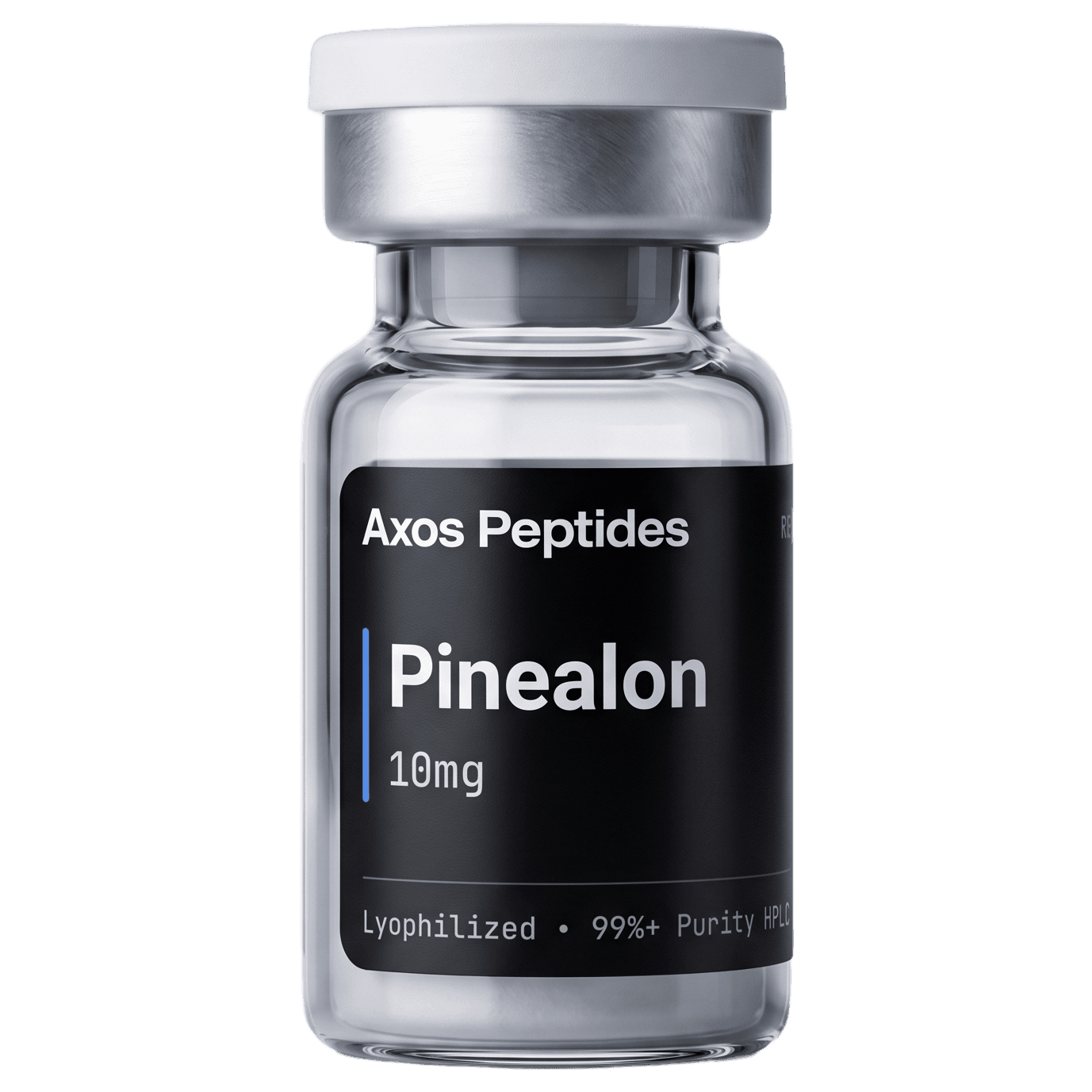
Pinealon is a three-amino-acid peptide: glutamic acid, aspartic acid, arginine. In single-letter code that is EDR, and much of the literature calls it the EDR peptide.12
It belongs to a family of very short peptides developed in Russia and often called bioregulators. Epithalon comes from the same programme, and the two are frequently discussed together.
Identity
- Glu-Asp-Arg
- Sequence
- EDR peptide
- Also called
- 3 amino acids
- Length
- None
- Published human trials
The study people cite
One animal study does most of the work in pinealon's reputation, and it is a specific experiment rather than a general one.
Researchers studied the offspring of rats with induced hyperhomocysteinemia. That means raised homocysteine, produced by loading the mothers' diet with methionine during pregnancy. Raised homocysteine is a recognised stressor on developing nervous tissue.1
Pinealon was given to the pregnant rats. In the offspring, researchers reported improved spatial orientation and learning ability.1
They also looked at neurons taken from the offspring's cerebellum. Those showed less accumulation of reactive oxygen species and fewer necrotic cells.1
The authors present this as confirming neuroprotective properties they had previously observed in cell culture.1
The proposed mechanism
How could three amino acids do anything at all? That is a fair question, and it is the one the mechanism work tries to answer.
The proposal is that ultrashort peptides act at the level of gene expression. The idea is that they reach the cell nucleus and influence which proteins get made. That is different from acting on a surface receptor, which is what most signalling molecules do.2
A 2020 review sets out this account for the EDR peptide specifically, covering gene expression and protein synthesis regulation.2 Related work has examined short bioregulatory tripeptides in cultured skin cells from young and old rats.3
This is a hypothesis with laboratory work behind it. It is not a settled mechanism. It is also the part of the field that draws the most scepticism from outside the programme.
How thin the record is
It is worth being direct about the size of the evidence base, because the marketing is not.
- No published human trial. Nothing in the record tests pinealon in people.
- The main animal result is a prenatal-stress model. It studied offspring of rats under a specific dietary challenge.1
- The mechanism is a proposal. Gene-expression regulation by ultrashort peptides is an account supported by laboratory work, not an established pathway.2
- One programme again. V. Kh. Khavinson is an author on the rat study and on the mechanism review.12 Independent replication elsewhere is what would change the picture.
- Claims about sleep and cognition in healthy adults have no published trial behind them.
Sources
Numbered as cited in the text · how we source
- 1
Pinealon protects the rat offspring from prenatal hyperhomocysteinemia
Arutjunyan A, Kozina L, Stvolinskiy S, et al. · Int J Clin Exp Med. 2012;5(2):179-185 · 2012
AnimalPubMed 22567179 - 2
EDR Peptide: Possible Mechanism of Gene Expression and Protein Synthesis Regulation
Khavinson V, Linkova N, et al. · Molecules. 2020;26(1):159 · 2020
ReviewPubMed 33396470 - 3
Effect of bioregulatory tripeptides on the culture of skin cells from young and old rats
Voicekhovskaya MA, Chalisova NI, et al. · Bull Exp Biol Med. 2012;153(3):387-389 · 2012
In vitroPubMed 22803085