Published research on the reference compound class. Provided for scientific context only. Not a claim about the product supplied.
A peptide hiding in mitochondrial DNA
Your mitochondria carry their own small genome, separate from the DNA in the nucleus. For years it was thought to code only for parts of the energy machinery. Then researchers began finding short hidden sequences in it that code for signalling peptides.1
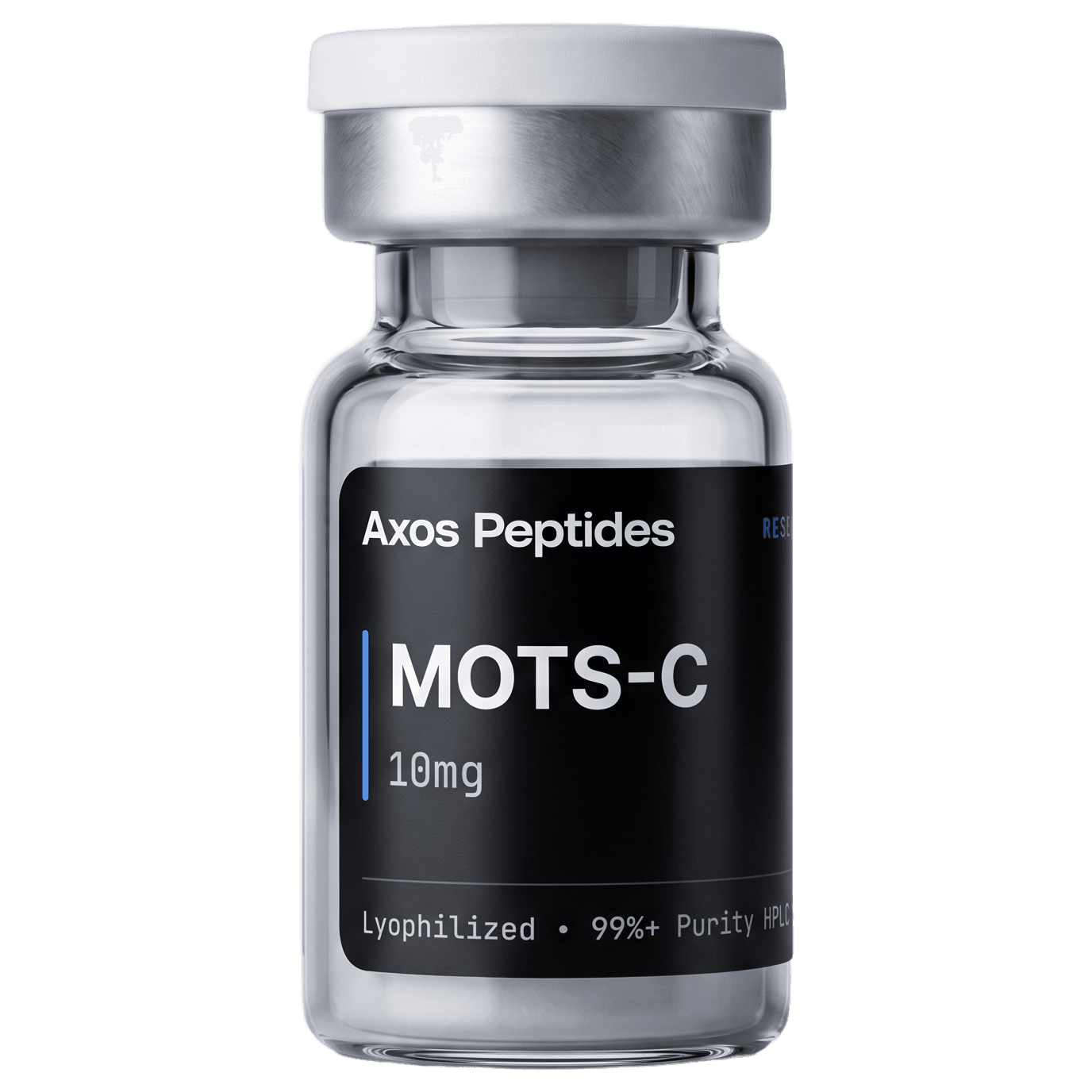
MOTS-c, short for mitochondrial open reading frame of the 12S rRNA-c, was described in 2015. It's just 16 amino acids long. Its main target appears to be skeletal muscle, where it nudges cell metabolism in a way that activates AMPK, the cell's master energy sensor.1
How MOTS-c works, in three steps
- It heads for muscle. Skeletal muscle appears to be its main target tissue.1
- It slows a metabolic assembly line. Inside cells, MOTS-c inhibits the folate cycle and the purine-building pathway tied to it.1
- The energy sensor switches on. That shift activates AMPK, the sensor cells use to manage fuel, and it's how MOTS-c improved insulin sensitivity in mice.1
MOTS-c isn't alone. It belongs to a small family of mitochondrial-derived peptides. The first one found, humanin, is what sent researchers looking for more hidden peptides in mitochondrial DNA.1
What the research reports
Most MOTS-c research so far is in mice and cells, and the headline findings are striking.
- Metabolism. In mice, MOTS-c treatment prevented the insulin resistance that comes with age and with a high-fat diet. It also prevented diet-induced fat gain.1
- Physical performance. MOTS-c improved physical performance in young, middle-aged and old mice. Even treatment started late in life, at about 23.5 months (elderly, for a mouse), increased physical capacity and healthspan.2
- Gene control. Under metabolic stress, MOTS-c travelled into the nucleus and regulated a broad set of genes, including antioxidant-response genes, working alongside the stress-response factor NRF2.3
Aging, it turns out, may be written in two genomes, not one.
What we know in humans
Human MOTS-c research so far is observational. It measures natural levels and genetics rather than testing the peptide itself. It's still fascinating.
| Study | Who | What researchers found |
|---|---|---|
| Exercise (2021) | Healthy adults | Exercise raised MOTS-c in muscle and in the blood2 |
| Aging muscle (2020) | Men aged 18–30, 45–55 and 70–81 | Blood levels fell with age, but muscle levels were about 1.5 times higher in older men5 |
| Genetics (2021) | 27,527 people in three cohorts | A MOTS-c gene variant found in East Asia was linked to higher type 2 diabetes rates in men, especially the least active4 |
| Lifespan (2015) | Japanese population | The same variant was proposed as one possible factor in exceptional Japanese lifespans6 |
The genetics work adds a neat twist. In mice on a high-fat diet, normal MOTS-c improved glucose handling, but the variant version didn't. A single amino-acid change was enough to blunt its effect.4
What we don't know yet
How MOTS-c is supplied
Our MOTS-c is supplied as a freeze-dried research peptide. Every lot is tested by an independent lab before release. Read the current certificate in the MOTS-c lab reports.
Sources
Numbered as cited in the text
- 1
The mitochondrial-derived peptide MOTS-c promotes metabolic homeostasis and reduces obesity and insulin resistance
Lee C, Zeng J, Drew BG, et al. · Cell Metabolism 21(3):443–454 · 2015
- 2
MOTS-c is an exercise-induced mitochondrial-encoded regulator of age-dependent physical decline and muscle homeostasis
Reynolds JC, Lai RW, Woodhead JST, et al. · Nature Communications 12(1):470 · 2021
- 3
The mitochondrial-encoded peptide MOTS-c translocates to the nucleus to regulate nuclear gene expression in response to metabolic stress
Kim KH, Son JM, Benayoun BA, Lee C · Cell Metabolism 28(3):516–524 · 2018
- 4
A pro-diabetogenic mtDNA polymorphism in the mitochondrial-derived peptide, MOTS-c
Zempo H, Kim SJ, Fuku N, et al. · Aging 13(2):1692–1717 · 2021
- 5
Increased expression of the mitochondrial derived peptide, MOTS-c, in skeletal muscle of healthy aging men is associated with myofiber composition
D'Souza RF, Woodhead JST, Hedges CP, et al. · Aging 12(6):5244–5258 · 2020
- 6
The mitochondrial-derived peptide MOTS-c: a player in exceptional longevity?
Fuku N, Pareja-Galeano H, Zempo H, et al. · Aging Cell 14(6):921–923 · 2015