Published research on the reference compound class. Provided for scientific context only. Not a claim about the product supplied.
What is GLP-3 RT?
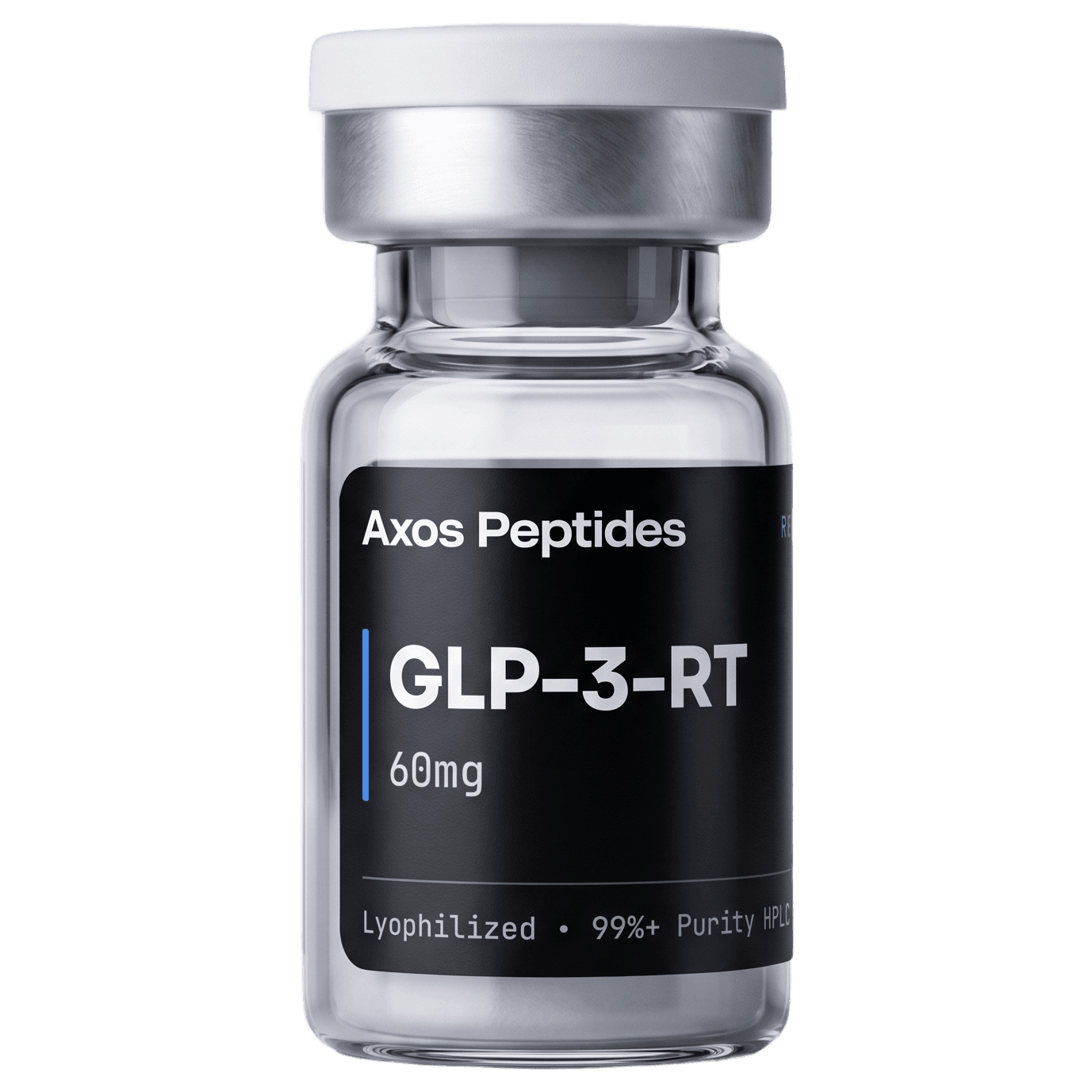
GLP-3 RT is our catalog name for a research peptide in the incretin family: lab-made mimics of the hormones your gut releases after a meal. The '3' is the headline. Its reference compound, the molecule studied in the published trials, is a single peptide built to activate three hormone receptors at once.1
Here's the team it switches on:
- GLP-1 receptor. Responds to a gut hormone involved in insulin release and appetite signals.
- GIP receptor. The second incretin receptor, also linked to insulin release after meals.
- Glucagon receptor. The wildcard. In mouse research, adding glucagon-receptor activity raised energy expenditure on top of the lower food intake driven by the other two receptors.1
The phase 2 numbers everyone quotes
In 2023, the New England Journal of Medicine published a 48-week, placebo-controlled trial of the reference compound in 338 adults with a high body-mass index. The main goal was to measure how body weight changed. The results made headlines.2
| Measure | Top study-dose group | Placebo |
|---|---|---|
| Body weight change at 24 weeks | −17.5% | −1.6% |
| Body weight change at 48 weeks | −24.2% | −2.1% |
| Reached a 5% reduction or more | 100% | 27% |
| Reached a 10% reduction or more | 93% | 9% |
| Reached a 15% reduction or more | 83% | 2% |
Two details stand out. First, the effect was dose-dependent: each step up in study dose produced a bigger average change. Second, the average kept falling between week 24 and week 48, from −17.5% to −24.2%.2
Beyond body weight: blood sugar and liver fat
The phase 2 program didn't stop at one trial. Two more studies looked at other metabolic markers.
Blood sugar. In a trial of 281 adults with type 2 diabetes, HbA1c (a long-term blood-sugar marker) fell by up to 2.02 percentage points at 24 weeks in the top study-dose group, versus almost no change on placebo. In the top groups, the drop was also larger than with an established GLP-1 comparator. Body weight in the top group was down 16.94% at 36 weeks.5
Liver fat. A substudy followed 98 participants with excess liver fat (a condition called MASLD). After 24 weeks, liver fat in the top study-dose group had fallen by 82.4%, versus a 0.3% rise on placebo. 86% of that group reached a normal liver-fat level, under 5%.3
From lab bench to trials in about two years
The reference compound was first fully described in 2022. In lab tests it showed balanced activity at the glucagon and GLP-1 receptors, with stronger activity at GIP. In mice, it lowered body weight and improved blood-sugar control. In an early human safety study, a single dose kept body weight lower for up to 43 days.1
A 12-week phase 1b study in 72 adults with type 2 diabetes came next. It reported dose-dependent drops in blood sugar and body weight, and a half-life of about six days.4 The phase 2 results followed in 2023, and the liver substudy in 2024.
How to read this research
What they do give researchers is a map: which receptors matter, which markers move and how fast. That's why the triple-agonist design is one of the most-watched ideas in metabolic research right now.
Every GLP-3 RT lot we sell is tested by an independent lab before release. The certificate shows the lot number and the exact measured HPLC purity. Read the current one in the GLP-3 RT lab reports.
Sources
Numbered as cited in the text
- 1
[Reference compound], a novel triple glucagon, GIP, and GLP-1 receptor agonist … from discovery to clinical proof of concept
Coskun T, Urva S, Roell WC, et al. · Cell Metabolism 34(9):1234–1247 · 2022
- 2
Triple-hormone-receptor agonist [reference compound] for obesity: a phase 2 trial
Jastreboff AM, Kaplan LM, Frías JP, et al. · New England Journal of Medicine 389(6):514–526 · 2023
- 3
Triple hormone receptor agonist [reference compound] for metabolic dysfunction-associated steatotic liver disease: a randomized phase 2a trial
Sanyal AJ, Kaplan LM, Frias JP, et al. · Nature Medicine 30(7):2037–2048 · 2024
- 4
[Reference compound], a novel triple GIP, GLP-1, and glucagon receptor agonist in people with type 2 diabetes: a phase 1b, multicentre, double-blind, placebo-controlled, randomised, multiple-ascending dose trial
Urva S, Coskun T, Loh MT, et al. · The Lancet 400(10366):1869–1881 · 2022
- 5
[Reference compound], a GIP, GLP-1 and glucagon receptor agonist, for people with type 2 diabetes: a randomised, double-blind, placebo and active-controlled, parallel-group, phase 2 trial conducted in the USA
Rosenstock J, Frias J, Jastreboff AM, et al. · The Lancet 402(10401):529–544 · 2023